Though the events of 53 BC had seen the comprehensive failure of the Carrhae campaign, the First Romano-Parthian War was far from over. We must therefore look at the aftermath of the campaign and the other years of the war before we can draw any overall conclusions about this period of history.
Rome after Carrhae
For Roman power in the east, the disastrous Carrhae campaign had a number of effects. In the first place, the Roman province of Syria (a long term Parthian target) now lay virtually defenceless. The legions stationed there had been taken by Crassus on his invasion of Parthia and had died along with him. Thus the province of Syria had neither governor, nor garrison. All it did have was around 10,000 legionaries (from across the seven destroyed legions) who had made it back from Carrhae. In terms of officers, the most senior man in Roman Syria was Gaius Cassius Longinus, who only held the rank of pro-quaestor and whose military capabilities had been seriously called into question during the Carrhae campaign.
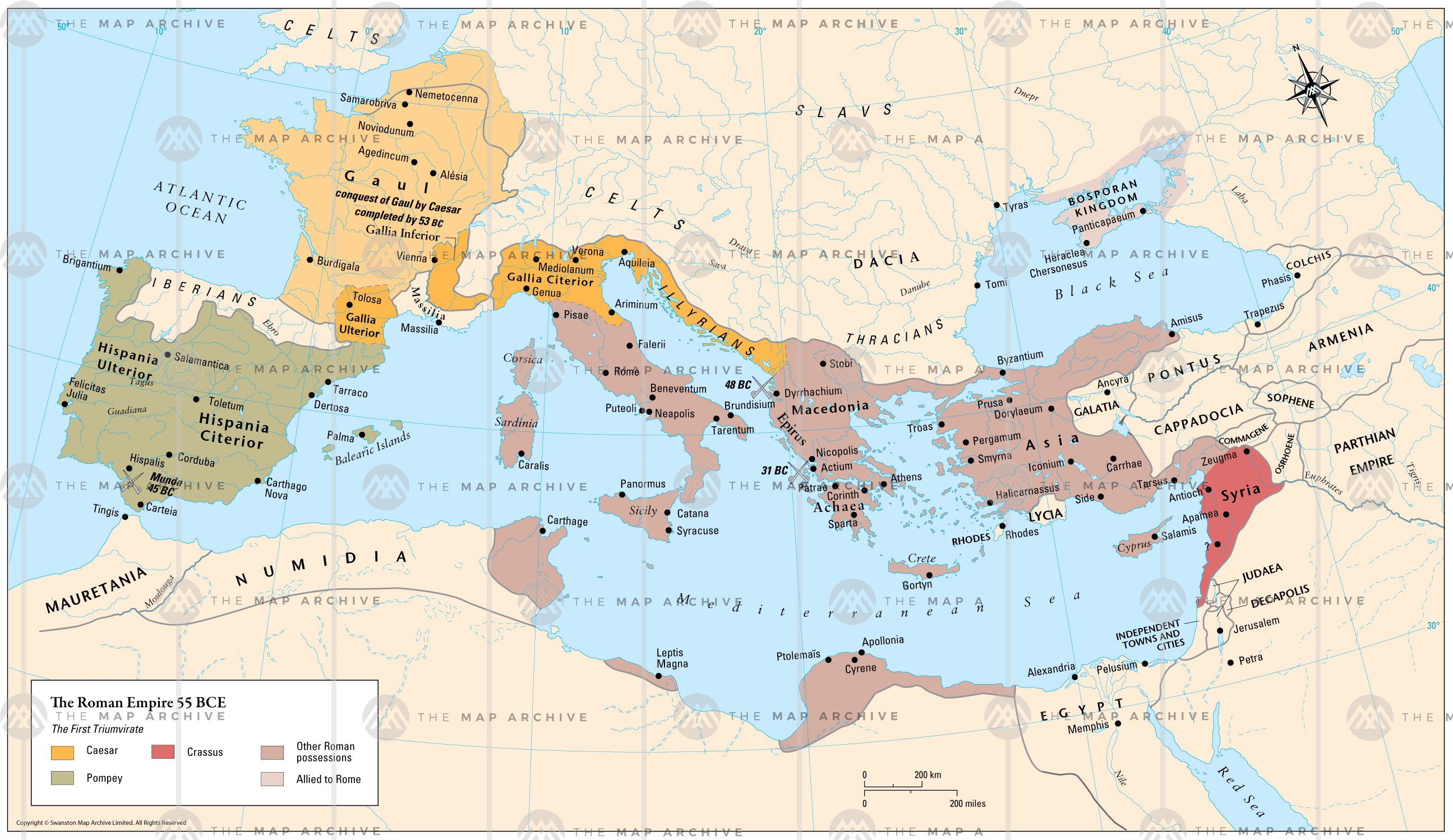
If this was not enough, then we need to consider the state of the Roman Empire in the east as a whole. The Pompeian settlement which had established Roman hegemony in the east was based on the power, image and threat of Rome, rather than a present physical force. The only territories that were Roman provinces were Asia, Bithynia & Pontus, Cilicia and Syria. Outside of Syria the only one of these with more than garrison strength was Cilicia, and that had less than 15,000 men stationed there. Most of the region was composed of client kingdoms who owed their allegiance to Rome due to a combination of past obligations and Rome’s overwhelming military superiority; and in matters of statecraft, past obligations tended to count for little. These kingdoms remained allied to Rome through the fear and respect that the Roman army had instilled in them. Thus the defeat at Carrhae had done more than simply cost the Romans a commander and his men; it had devastated their military reputation in the region at the expense of their neighbour and rival.
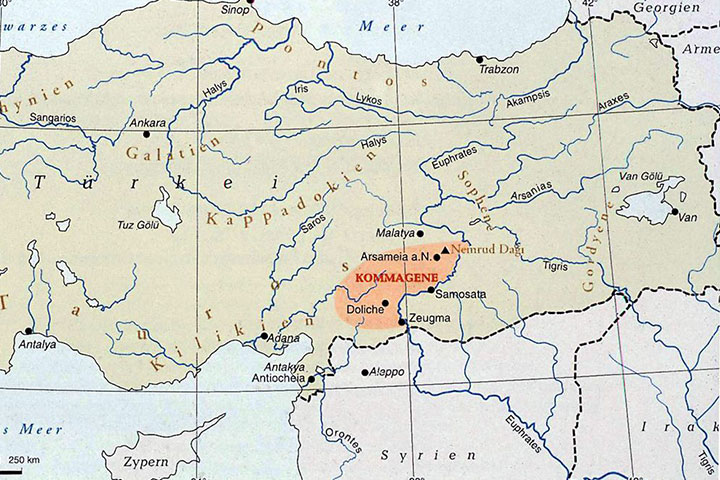
Of these client kingdoms, the greatest of them, Armenia, had already moved from the Roman sphere of influence back into the Parthian one. In the region of the northern Euphrates lay two minor client kingdoms: Osroene and Commagene. Abgarus, the ruler of Osroene, wasted no time in affirming his allegiance to Orodes and dismissing any talk of him aiding Crassus (as seen earlier) as being nothing more than a double bluff. He probably attempted to claim some of the credit for leading Crassus into defeat at Carrhae. The Kingdom of Commagene appears to have remained loyal to Rome in the short term, but could do little about the Parthians crossing the Euphrates and invading them, other than warn the Romans. Should the Parthians do so, then Commagene would have to swear allegiance to Orodes. Cappadocia had just gained a new young king, whose grip on the throne was tenuous at best and so was of little use to Rome and actually gave them another source of concern.261 This left the kingdom of Judea in the south, which had been a perpetual source of revolt for the Seleucids and had already twice required Roman intervention in the past decade (Pompey in 63 and Gabinius in 55). Given their past reputation and perpetual internal chaos, it is not surprising that when the news of the Roman defeat at Carrhae reached them, yet another anti-Roman insurrection broke out.Even within Syria itself, anti-Roman elements were agitating against the Romans. All in all, the situation that Rome faced in the east was grave. Leadership and decisive action would be needed by the Senate, and Rome’s two surviving triumvirs, if the situation was to be salvaged.
Unfortunately for the Romans in the east and the Republic as a whole, the Senate and Rome’s leading men were apparently too busy with domestic politics to bother about a catastrophic situation on the edges of their empire. For much of 53 BC the Republic was without formal government. It was not until July that consuls for that year were elected (rather than during the previous year). This situation was symptomatic of the chaos that had broken out in Rome. Following Crassus’ departure for the east, Caesar became bogged down in Gaul and an abortive invasion of Britain, leaving Pompey to manage affairs in Rome. Furthermore, a bribery scandal had broken out during the elections for the consuls of 53 BC, which resulted first in political deadlock and then outright chaos, as the elections were continually prevented from being held. Old political scores were being settled both in the courts (Gabinius was tried twice for his actions in Egypt and finally convicted) and ultimately on the streets, with Clodius and Milo both re-arming their gangs and bringing armed fighting onto Rome’s thoroughfares once more. Pompey had to absent himself from Rome to see if the chaos died down. By the time he returned and used his authority and political power to get the elections held for the consuls of 53 BC, attention immediately turned to the elections for the consuls of 52 BC, and thus the whole cycle of political chaos was sparked off once more. It was into this chaos that news of the disaster at Carrhae arrived.
It appears that few tears were shed by the Senate and people of Rome over the loss of Crassus. It also appears that both groups failed to appreciate the gravity of the situation in the east. As for Crassus’ former colleagues, Caesar was still fighting for his life suppressing rebellions that had broken out all over Gaul and even striking out across the Rhine to stabilise his new conquests, and Pompey was trying to hold the situation in Rome together and hoping to profit by it. Therefore neither man had time to worry about the eastern frontier.
In the midst of this turmoil we are unsure how the news of the disaster at Carrhae was received. It came on the heels of a reversal for Caesar in Gaul (a rebellion had broken out, which resulted in the loss of a legionary camp and a whole legion with it). Thus it was possible that Carrhae was seen as one disaster amongst many, which could have lessened its impact on the minds of the people in Rome. It was only after the chaos of 53 and 52 BC had subsided that people had time to assess the defeat, and Crassus’ part in it. However the situation in Rome at this time is difficult to judge because there are large gaps in the surviving collections of Cicero’s letters (our best source for the period), which affect 53 BC in particular. There is no doubt that Cicero would have recorded the news of Carrhae, but regrettably those letters have not survived (appendix two will deal with possible other sources for the Battle of Carrhae).
The year 52 BC opened up with the by-now-familiar sight of election chaos and no fresh consuls elected. The situation got markedly worse when a battle between the gangs of Clodius and Milo ended with the murder of Clodius. In anger his supporters built a funeral pyre inside the Senate House and set light to it, resulting not only in the cremation of Clodius’ body, but also the destruction of the building. This crisis resulted in a proposal being made for an emergency government in the form of a sole consul. The man proposed was Pompey himself, and with the Senate’s backing the Republic chose to have a sole consul for the first time. Pompey cemented his power within Rome and the Senate by hastily arranging to marry the newly-widowed wife of Publius Crassus, which even the Roman elite found somewhat distasteful but which again showed his political acumen by taking advantage of a crisis.
One of the emergency laws which Pompey passed specified that there should be a five year gap between a consul holding office and gaining a provincial command. Naturally, Pompey himself was exempted from this law. It was only as a consequence of this law, and the resultant shortage of provincial governors that it led to, that finally in 51 BC the Senate turned to the issue of the east and its governance.
In what was little more than a provincial house-keeping exercise, the Senate appointed new governors of Cilicia and Syria. In accordance with this new five year rule, they had to appoint men who had been consuls some years before. For Cilicia they chose Marcus Tullius Cicero himself (the consul of 63 BC), who had spent the years following his consulship in writing numerous legal, political and philosophical tracts and working in the courts. For Syria they chose Marcus Calpurnius Bibulus (the former Consul of 59 BC) who had spent most of his consulate closeted in his own house looking for ill-omens with which to veto the legislation of his colleague, Julius Caesar. Neither man therefore inspired any confidence in their ability to handle a military crisis. To show just how little the Senate understood of the situation in the east, Cicero’s proposal that fresh legions should be levied in Italy in order to strengthen the forces on the borders of Syria and Cilicia was vetoed by the consul Sulpicius.266 Though the Romans may not have thought it, we are fortunate that Cicero was one of the men chosen to go to the east, as his numerous surviving letters give us a first-hand testimony of events there.
Thus the reaction in Rome to the catastrophic Carrhae campaign, and its perilous position in the east as a whole, was one of almost complete disinterest. As always happened in Roman Republican politics, the affairs of Rome itself took precedence over the affairs of their empire. Those men who did realise the threat, and Cicero must count amongst them, especially once he had been sent out to the east, did not have sufficient political weight to do anything about it. The only men with enough political power in the 50s BC were Crassus’ colleagues, Pompey and Caesar, and both men were too busy with their own problems and affairs, and with each other’s, to turn their attention to the crisis in the east. The death of Crassus may have been a disaster for Rome, but it was also an opportunity for Pompey. His old rival of over twenty years had been removed and it is no surprise that Pompey’s third consulship was a sole one (the first two having been with his equal, Crassus, in 70 and 55 BC). Pompey now saw himself as a man without equals.
Thus the Romans showed total disregard for the east and the potential Parthian threat. The defence of Syria, and Rome’s whole position in the east, fell upon the shoulders of one man, Gaius Cassius, who had less than two legions of Carrhae survivors with which to accomplish this.
Parthia after Carrhae
Parthia, however, after the victorious Carrhae campaign, had just the opposite problem: how to build on the successes of 53 BC? Once again we suffer from a lack of non-Roman sources here. For the remainder of 53 BC the Parthians did not appear to cross the Euphrates, and Dio tells us that, quite logically, they spent the rest of the year reasserting control of the territories east of the Euphrates. The Roman garrisons may have fled along with Crassus, but Parthian control needed to be reinforced in these towns considering how easily they had gone over to the Romans. The same would have been true of the cities of Babylon and Seleucia, which were known to harbour pro-Roman sympathies and which had gone over to Mithradates III during the civil war of 55/54 BC.
A full-scale invasion of Syria would take some time to plan, especially since the bulk of the army was with Orodes in Armenia and they had not been expected to mount an offensive operation so soon, if at all. Orodes had another headache: who would lead this invasion? The obvious choice would have been Surenas, but Orodes had already had him murdered to secure his own throne. Whilst this brutal and treacherous action may have been in Orodes’ own best interests, it certainly was not in Parthia’s, for it robbed the Parthians of one of the most talented generals they ever possessed. Not only that, but it is unlikely that the Suren clan (Parthia’s most powerful, after the Arsacids), would have taken the murder of their chief easily. So the murder of Surenas may have stirred up trouble within Parthia, which would need to be dealt with before offensive action could be taken.
Whilst this internal reorganisation was going on, however, there were certain measures the Parthians could take to strengthen their position against Rome. Firstly, the Parthians could secure their alliances with some of the smaller states of the region. Certainly the area of Osroene quickly came back into the Parthian fold, and it is probable that a number of the other semi-autonomous Arab tribes that bordered the Roman and Parthian empires would have switched their loyalties to Parthia. Secondly, Parthia could encourage pro-Parthian elements in both Syria and Judea to overthrow Roman rule and destabilise the region prior to a Parthian invasion; ironically just as Rome had done to the Mesopotamian region in 55 BC (by sending Mithradates III back to stir up a civil war). In Judea, little such encouragement was needed and the result was perfect for Parthia – a full-scale insurrection against Roman rule.
52 BC – The Calm before the Storm
The year following Carrhae was an unusually quite one in terms of the war between Rome and Parthia. Rome was still too busy with domestic politics to bother about the east and Parthia was still going through an internal reorganisation. For one man, however, it was a year that would be a highly active one, and one that would go some way to restoring his reputation. That man was Gaius Cassius Longinus. We know little of Cassius prior to the Carrhae campaign. He came from a consular family which had a steady, but unspectacular, lineage in Republican terms.267 Given the later offices which he held, we can estimate a date of birth of somewhere in the late 80s BC for Cassius.268 Thus he was still a young man in his late twenties or early thirties when he was taken under Marcus Crassus’ wing, as had been done with many young ambitious aristocrats (including Julius Caesar). By the autumn of 53 BC he found himself, by process of elimination, as the governor of Syria and the man in charge of defending Roman interests in the whole region in the face of an impending Parthian invasion. Given his track record during the Carrhae campaign (he had fallen for Surenas’ ruse and deserted his commander), the omens were not looking good. However, when put in this high pressure situation at such a young age, he appears to have come into his own.
For the events of 52 BC, Josephus is again our best source; Cicero had not yet been appointed and thus he largely ignored the situation. Josephus states that the Parthians pursued the Romans across the Euphrates, which does contradict Dio’s account . However, it would have been a good Parthian tactic to send raiding parties across the Euphrates whilst they were preparing for a full scale invasion. Meanwhile, Cassius formed the survivors of Carrhae, including at least 800 cavalry, into two legions and set about repelling the incursions, which he did with some considerable success.270 Once the Parthian raids of early 52 BC had been repulsed, Cassius set about securing the region by tackling the growing problem of the Jewish insurrection. This rebellion was led by a man called Peitholaus, who was attempting to revive the rebellion led by King Aristobulus, which had been crushed by Pompey in 63 BC. Cassius dealt with this fresh rebellion in similarly brutal fashion. With only two legions he stormed the city of Taricheae and enslaved over thirty thousand inhabitants who had been supporting the rebellion; Peitholaus was executed. In crushing this rebellion, Cassius had the friendship and support of an influential Judean Arab by the name of Antipater, who was to become the father of the infamous King Herod the Great. When he was confident that Judea had been pacified, Cassius returned to the Euphrates region to deal with further Parthian incursions. Once again it is reported that he did so successfully.
Thus for Cassius and ultimately Rome, 52 BC had brought some much-needed stability and some limited successes. Roman Syria was no longer leaderless or undefended. Cassius had formed the survivors of Carrhae into two efficient legions, had routed a number of Parthian border incursions and had successfully crushed an insurrection in Judea. He had done so with a ferocity that would have made any other anti-Roman elements in the region think twice. All in all it had been a good year for Cassius, who had restored both his own and Rome’s reputation. Even so, some of the responsibility for these Roman successes must be laid at the door of the Parthians, who wasted a whole year’s campaigning in internal re-organisation and planning. This year-long respite allowed Cassius to regroup and forge an effective defence force in Syria to secure the border and restore Roman authority over the region. Again we can see the indecisive hand of Orodes behind this delay. Had Surenas still been alive then it is highly unlikely that the Romans would have had the luxury of eighteen months to await the Parthian invasion. Nevertheless, repulsing border raids was one thing, repulsing a full-scale invasion was another.
51 BC – The Parthian Invasion of Roman Syria
On 14 June 51 BC, as he was on his way from Italy to take up his command in Cilicia, Cicero wrote to his friend Atticus expressing the sentiment ‘Only let the Parthians keep quiet and luck be on my side’.272 He was soon to be disappointed.
At some point during 52 BC, Orodes finally made the decision to invade and conquer Roman Syria. He also came to a decision on who was to lead the expedition, naturally not wanting to take the risk himself. He opted for a joint command and a blend of youth and experience. Nominally in command of the invasion was one of his own sons, Pacorus, who appears to have been Orodes’ favourite son and his heir. Aiding him was a veteran Parthian noble general, Osaces.273 Thus Orodes appears to have opted for a ‘safety first’ mentality to the campaign. Clearly he did not want another Surenas, but recognised the need to temper his son’s youthfulness with an experienced soldier.
We can track the prelude to the first Parthian invasion of the Roman Empire through Cicero’s letters as he crossed the Mediterranean en route to Cilicia. From Athens on 6 July 51 BC he wrote:
Of the Parthian, there is no whisper. As for the future, heaven be my help.
Then on 27 July, from Asia Minor:
Meanwhile certain welcome reports are coming in, first of quiet from the Parthian region.
Having reached Cilicia he wrote on 3rd August:
I reached Laodicea on 31st July. My arrival was most eagerly anticipated and widely acclaimed.
We can also see how little Cicero was looking forward to his military duties from this:
Contrary to my inclination and quite unexpectedly, I find myself under the necessity of setting out to govern a province.
And, with growing desperation, this:
For mercy’s sake, as you are staying in Rome, do pray first and foremost build up a powerful defensive position to ensure that my term remains only one year.
How inadequate he thought his resources is also made plain:
And to think that while our friend [Pompey] has his huge army, I have a nominal force of two skeleton legions. But I’ll stick it out as best I can so long as it’s only for a year.
By 14 August, rumours were beginning to reach Cicero which made him think that it was not going to be his year:
Of the Parthian there is no whisper, but travellers say that some of our cavalry have been cut to pieces by the barbarians. Bibulus [the new governor of Syria] is not so much thinking of getting to his province even now.
By 28 August Cicero received the news that he had been dreading:
Ambassadors sent to me by Antiochus of Commagene have arrived at my camp near Iconium on the 28th August, and having reported to me that the son of the Parthian King, whom the sister of the Armenian King had married, had reached the banks of the Euphrates with a large Parthian force and a large army of many other nations besides, and that it was said that the Armenian King intended an attack upon Cappadocia.
By 20 September Cicero gave a further grim assessment of the situation:
the Parthians have crossed the Euphrates under Pacorus, son of King Orodes of Parthia, with almost their entire force. There is no word of Bibulus being in Syria. Cassius is in the town of Antioch with his entire army.
Despite this, his major concern is still for his own governorship:
but first and foremost (ensure) that nothing is added to my responsibilities or my tenure twixt the slaughter and the offering [twixt cup and lip] as they say
He then gives a brutally honest summary of his own position:
For with an army as feeble as mine and so little in the way of allies, loyal ones particularly, my best resource is winter. If that comes without the enemy invading my province first, my only fear is that the Senate will not want to let Pompey go in view of the dangers at home. But if they send someone else by the spring I shall not worry, as long as my own term is not extended.
Thus we have Cicero’s strategy for dealing with the first full-blown Parthian invasion of the Roman empire: pray winter arrives before the Parthians do and hope that the Senate either sends Pompey out to deal with the Parthians, or a replacement for Cicero as governor of Cilicia. Fortunately for the Romans, the Parthians did not invade Cilicia, but made straight for the jugular of Roman Syria.
Cicero’s letter of 28 August gives us a fair idea of the Parthian plan and the nature of their attack, though he does not provide us with an overall figure for the Parthian numbers, which he probably did not have himself at the time. Fortunately, we do possess Cicero’s report to the Senate, sent at some point in the autumn of 51 BC, which outlines the whole situation and provides us with invaluable information:
I received a dispatch from Tarcondimotus, who is regarded as our most loyal ally, beyond Mount Taurus, and the best friend of the Roman people. He reported that Pacorus, son of Orodes, the Parthian king, had crossed the Euphrates with a very large force of Parthian cavalry, and pitched his camp at Tyba, and that a serious uprising had been stirred up in the province of Syria. On the same day I received a dispatch dealing with the same incidents from Jamblichus, the leading tribesman of the Arabs, a man who is generally considered to be loyally disposed and friendly to our Republic. On the receipt of this information, I fully understood that our allies had no firmly established opinions, and were wavering in their expectation of a revolution.285
From these two pieces of testimony we are able to piece together the Parthian battleplan for their invasion of Syria. Pacorus and Osaces crossed the Euphrates and headed deep into Syria with a large army. This force was mostly composed of cavalry, thus copying Surenas’ tactics, as well a large contingent of allied forces, most likely to be from the tributary Arab territories. Some commentators have criticised this force as being nothing more than a large raid, rather than an army of conquest, because of the preponderance of cavalry.286However, this view fails to understand the subtle nature of the Parthian plan. The invasion force was not there to take every city in the province by storm, but to defeat the remaining Roman forces, and then be invited in by the inhabitants of the Syrian cities, who would want to overthrow Roman rule. In many ways this appears to have been a copy of their highly successful invasion of Mesopotamia in the 140s BC, where, after the Seleucid forces were defeated, the Parthians appear to have been welcomed into the cities by the inhabitants.
To ensure the success of this strategy, the Parthians had engineered a general uprising throughout Syria, through use of agents and pro-Parthian forces. There would have been many inhabitants of Syria, who believed that they had more in common with Mesopotamia and the east than with the inhabitants of Italy, and would have seen their being part of an eastern empire as the more logical. If nothing else, the defeat of Rome at Carrhae had shown that it was Parthia, rather than Rome, which appeared to be the ascendant power. This plan also explains the predominant cavalry element of the Parthian army; they were copying Surenas’ tactics and had designed this force not to storm cities, but simply to defeat and destroy the remaining Roman forces in the region.

 Visit Turkey
2 replies on “Storm Over the East (53–50 BC)”
Fantastic information, very instructive, many thanks.
LikeLiked by 1 person
Defeat of Rome in the East: Crassus, the Parthians, and the Disastrous Battle of Carrhae, 53 BC
Book by Gareth C. Sampson
Recommended
LikeLike