Author:Bruce Masters
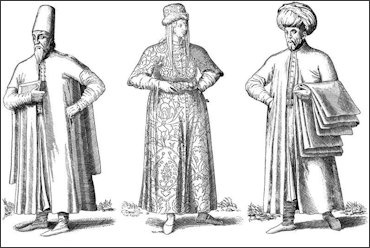
The word millet comes from the Arabic word for nation, milla, but in the Ottoman Empire it came to mean a religious community, specifically, non-Muslim religious minorities represented within the empire by an official political leader. Official Ottoman correspondence dealing with the non-Muslims of the empire in the early 19th century consistently affirmed that nonMuslims were organized into three officially sanctioned millets: Greek Orthodox, headed by the ecumenical patriarch, Armenians, headed by the Armenian patriarch of Istanbul, and Jews, who after 1835 were headed by the hahambaşı in Istanbul. The bureaucrats further asserted that this had been the tradition since the reign of Sultan Mehmed I (r. 1413–21). The millets as constituted in the 19th century were hierarchically organized religious bodies with a decidedly political function. Each was headed by a cleric (patriarch or chief rabbi, known in Ottoman Turkish as the millet başı) who was appointed by the sultan, usually from a list of candidates provided by the community’s leaders, and resident in Istanbul. But beyond that, the millet başı was largely free to order the affairs of his community as long as he remained loyal to the sultan. More importantly, as an officially sanctioned bureaucracy, the millet’s leadership could command the civil forces of empire, such as governors and kadıs, to implement its will over an errant flock.
Many historians have accepted the 19th century bureaucrats’ claim at face value and have asserted that the millet system as it existed in the 19th century had been a part of Ottoman rule since the 15th century. Recent scholarship has shown it was, in fact, a relatively recent Ottoman political innovation, even if its workings were always cloaked in the rhetoric of an ageless tradition.
By the late 18th century, the Ottoman authorities were consistently intervening in disputes within and among the religious communities to support the established religious hierarchies against internal dissent. This was especially true within the Christian communities where there was conflict between Catholic and Orthodox Christian factions that eventually split every Christian millet into two competing bodies. Unlike the Christian churches, the Jews of the empire did not have a pre-existing clerical hierarchy. In the place of patriarchs and bishops, their religious communities functioned autonomously in each of the Ottoman cities they inhabited. Although the Jews were recognized as a separate religious community by both Muslim legal scholars and Ottoman officials, the Jews did not seek formal status as a millet until 1835 when the Ottoman government, in its attempt to standardize the way it dealt with each of the minority religious communities, pushed the Jewish community leaders to name a chief rabbi (hahambaşı) for the empire.
After the start of the Greek War of Independence in 1821, the prestige of the Orthodox ecumenical patriarch in Istanbul plummeted and the special relationship that had existed between the Greek Orthodox Church and the sultan ended. Faced with pressure from the European Catholic powers, notably France and Austria, the Ottomans recognized the Catholics as a millet in 1830. Later, that millet would only include the Armenian Catholic community, as the various other Uniate communities (those Christian sects that recognized the Roman Catholic pope as their spiritual head) pressed for recognition on their own behalf. By the end of the empire, the Ottoman officials recognized 12 separate Christian communities as millets.
During the Tanzimat reform period of the mid19th century, the Ottoman government pushed the millets to reform their internal governance, including school systems directed independently within each community. Reform was usually resisted by the clergy and advanced by the laity as a way of wresting some political authority away from the clerics. In 1863 the Armenians were the first community to write their own constitution governing the internal laws of their millet. This constitution transferred much of the community’s governance to an elected body of laity and clergy. The Orthodox and Jewish communities soon followed, although their experimentation was much less democratic than that of the Armenians. Some historians have seen this trend in local governance among the various religious communities as contributing to the rise of nationalist sentiments among the various Christian communities where religion and nationality could be conflated. The children of the communities were educated separately from Muslims and primarily in the language of their community. They were also taught the separate history of their community and its culture. It is this separate education that many believe inspired these groups to see themselves as separate peoples.

 Visit Turkey