Categories
Asia Minor

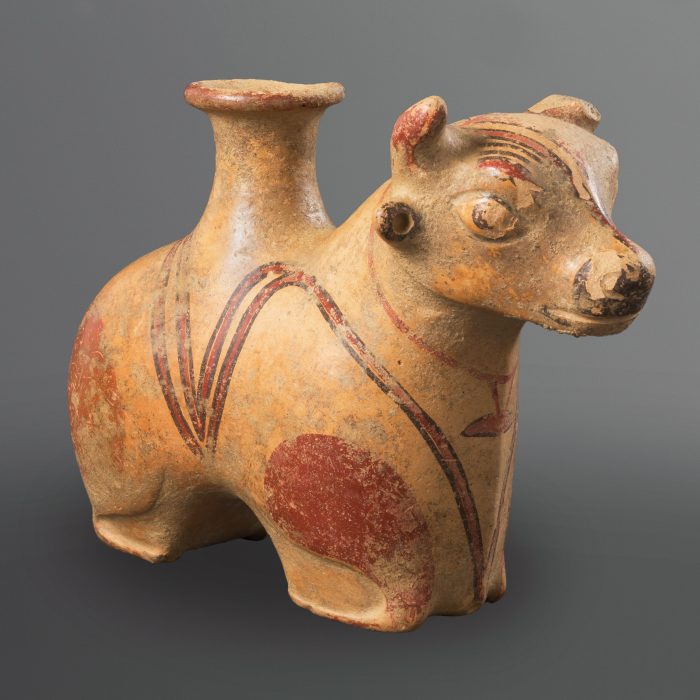
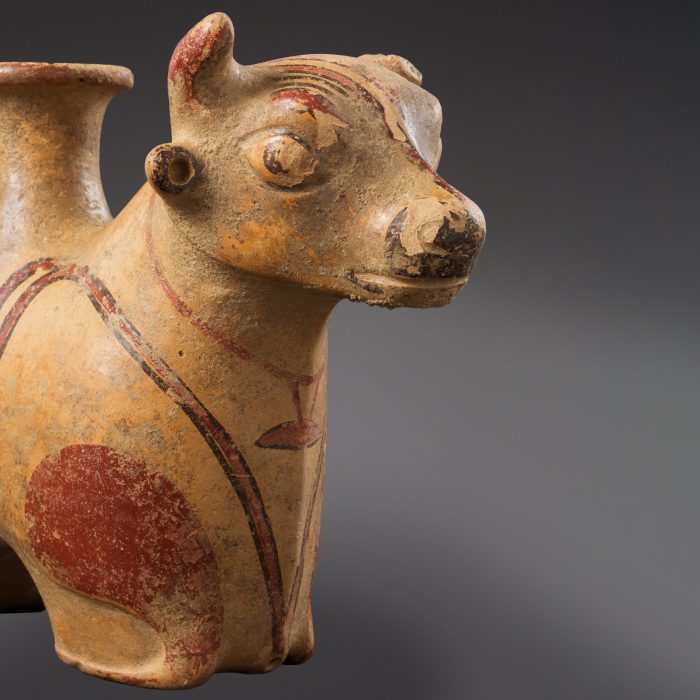
Phrygian Terracotta Rhyton in the shape of a Seated Bull,7th Century B.C.

© 1968 – 2021 Phoenix Ancient Art. All rights reserved.

This hand-modeled rhyton represents a bovid seated with its legs folded under its body, which may be identified as a bull or a calf. The terracotta is now of a yellow ocher color, highlighted with reddish brown and black paint for the details of the coat (patches on the shoulders, haunches and head), for the tail and for the lines that probably indicated garlands (around the chest, shoulders, collar, head and hindquarters).

A tall cylindrical opening, provided with a rounded lip and certainly used to fill the vessel, is placed on the back of the animal, while a small circular opening, pierced at the bottom of the chest, between the front legs, allowed limited pouring of the liquid by the simple covering of a finger.

The body of the animal is squat, with powerful proportions and well rounded, though poorly detailed and hardly realistic volumes. The lower legs, however, are represented only by thin stems in low relief, which terminate in hooves and constitute the support points of the vessel.

The head, which enables us to confidently identify the animal as a bovid, has a strong and massive structure that reveals the triangular shape of the skull. Unlike the body, its modeling is more realistic, both in the overall shape and through the presence of many accurate anatomical details (eyes, brows, incised nostrils, horizontal mouth, jaw in relief, etc.) highlighted by red and black paint.

The ornamental motifs covering the body and the head (triangles on the forehead and pendants between the horns) characterize this animal as sacred, perhaps sacrificial: like many other related rhyta, this vessel was no doubt used for libations during religious ceremonies, the precise nature of which still remains enigmatic. It can even be imagined that by depicting the exact pattern of an animal intended for sacrifice, the vessel would somewhat replace the real animal, like a sort of permanent offering.

While belonging to the rich and large series of animal-shaped rhyta originating in Anatolia and in the Near East from the late 2nd millennium B.C., this example does not currently have any specific parallels, which prevents us from suggesting a precise chronology: it should nevertheless be dated between the late 8th and the 5th century B.C. Among the best comparisons, one should mention the rhyta in the shape of a seated horse (from Maku, Western Azerbaijan Province, Iran) and in the shape of a standing horse (from Susa, Khuzestan Province, Iran), also adorned with richly painted patterns (8th-7th century B.C.), as well as the terracotta example from Ardabil, slightly coarser and darker (late first half of the 1st millennium B.C.). In central and eastern Anatolia, the ornaments in the shape of bulls’ heads adorning the cauldrons from Gordium (Tumulus MM, late 8th century B.C.) are typologically similar, like the protome of a rhyton in the shape of a horn found in Armavir (Armenia, 6th-5th century B.C.).

Technical and stylistic similarities also exist with a type of ceramic (yellow ocher background, linear decoration painted in red and black) from the eastern regions of Anatolia and that archeologists date to the 7th century B.C.

Rhyta were widespread in the ancient world: the first documented examples are those of Tell Halaf (Syria, 6th-5th millennium B.C.), but their shape quickly became the norm in Mesopotamia, in Egypt, in the Aegean cultures of the Bronze Age and, later, in classical Greek and Roman civilization. Although rhyta may vary in their typology, they are almost always linked to the world of animals and fantastic beings: they may be modeled in the shape of an animal (like our example) or in the shape of a horn with the protome of an animal or a monster; or, in the classical world especially, they may be composed of a wide mouth with a handle and of a head depicting various animals, women, blacks, satyrs, small groups with two figures, etc. These vessels were used primarily to make libations by pouring the offered liquid to the deity (their Greek name, ρυτοσ, means drinking, pouring vessel).

Art market, prior to 1964;

Ex Maurice Boss Collection, Geneva, Switzerland; ex Dr. L. Collection, Switzerland, acquired in 1964.
Categories
Asia Minor

Millawanda

The identification of this with Classical Miletos, long the focus of fervent scholarly debate, is of crucial significance for the interpretation of the historical geography of Late Bronze Age western Anatolia. If it is placed much further north near the Sea of Marmora, in the area here identified as Wilusa, then a whole string of geographical locations has to follow. This did seem perfectly arguable, along with locations for a number of lands further east and closer to the Hittite homeland, before the discovery of new inscriptions of Tudhaliya IV. All these clarify points of geography, not least among these being the Bronze Tablet. Linguistically, there has been some doubt about the identification of Millawanda with the Greek form Miletos, owing to the disparity with the Late Bronze Greek (Mycenaean) form of the name. On the other hand, the Hittites, unfamiliar with this place-name, may well have given it a form more acceptable to them, by adding the suffix -wanda, occurring in some 50 names, while the prefix mil- is common in Hittite contexts. The weight of probability therefore now favors equating Millawanda and its alternative form Milawata with Miletos, fitting in with the archaeological evidence. In the third year of Mursili II, Millawanda became in some way involved in an anti-Hittite alliance led by Uhhaziti, king of Arzawa, and by Ahhiyawa. Hittite commanders were dispatched against Millawanda. Though this may have been little more than a raid, the destruction of Level II at Miletos, revealed by excavations, could be connected with this Hittite intervention, lacking textual support. Miletos throve as a port, on the maritime trade, yet was geographically isolated from the Anatolian hinterland, explaining the evident inability of Mursili II to retain control of Millawanda-Miletos. The pottery of both Troy and Millawanda, however, shows changes in the phase termed by Mycenaean scholars Late Helladic IIIB which could reflect the destruction of greater Arzawa by Mursili II and its reduction to a number of vassal kingdoms.

valley to Iyalanda-Alinda. From the city of Iyalanda he attacked the land of that name, then advancing to the boundary of Millawanda, which probably extended across the isthmus of the peninsula on which Millawanda stood. There he negotiated the surrender of the renegade fugitive Piyamaradu. It is quite clear that Millawanda was now ruled by Ahhiyawa. Although it might be thought that Millawanda was of major significance to the Hittite kings, it meant much more to the Mycenaean merchants and settlers from Ahhiyawa. In fact, Millawanda is mentioned in only three Hittite sources, the Extended Annals of Mursili II and the Tawagalawa and Milawata letters of Hattusili III and Tudhaliya IV respectively, in the latter commanding but three lines. The Hittite kings were more concerned with territories a little removed from the coast; and it seems that Tudhaliya IV, in addressing “my son,” was writing to Tarkasnawa, king of Mira, who was holding the ruler of Wilusa, Walmu. In the generations following the end of the Hittite Empire and of the Late Bronze Age world, many settlements in western Anatolia perished; but major communities, including Miletos, survived. Indeed they prospered, with the whole region, benefiting from the immigration of Aeolian and Ionian settlers from across the Aegean Sea.

Categories
Asia Minor Early Modern Medieval Orient ottoman period

Pastirma

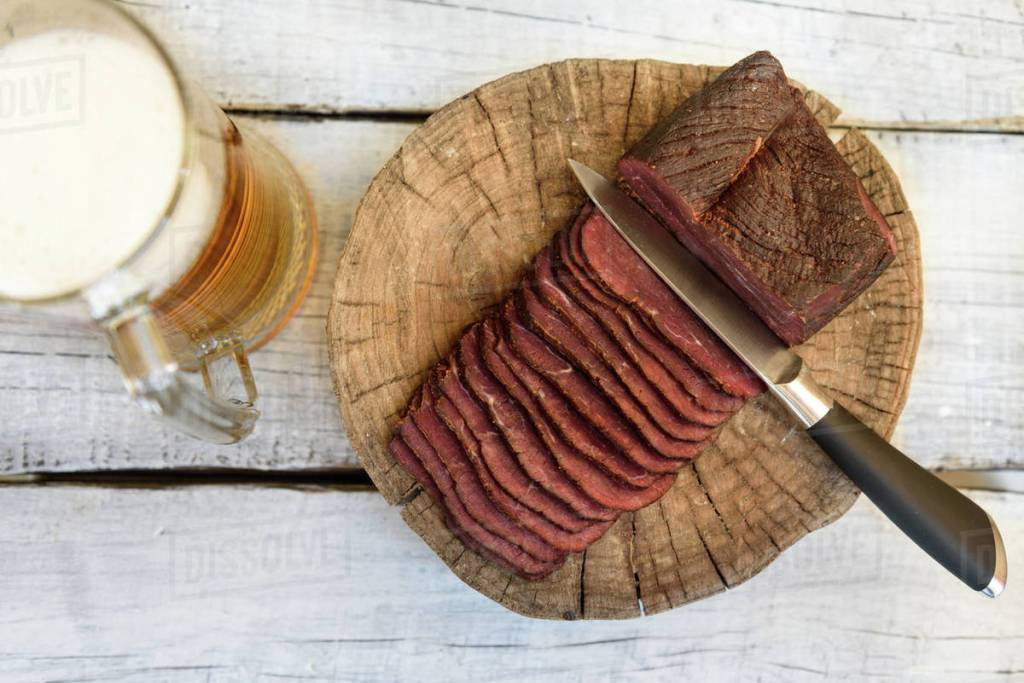
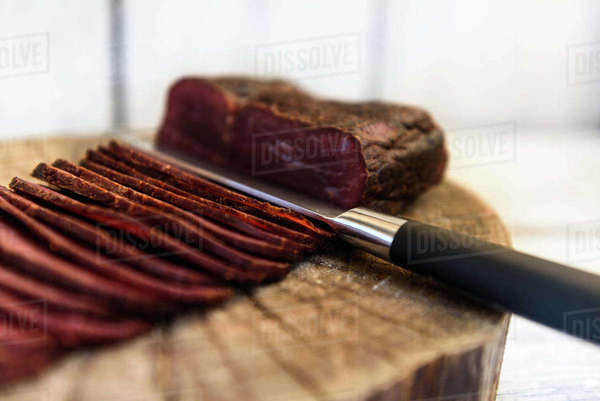
pastrami beer in a glass knife on a wooden table
contributor: Omelnickiy

The Turkish horsemen of Central Asia used to preserve meat by placing slabs of it in pockets on the sides of their saddles, where it would be pressed by their legs as they rode. This pressed meat was the forerunner of today’s pastirma, a term which literally means ‘being pressed’ in Turkish, and is the origin of the Italian pastrami. Pastirma is a kind of cured beef, the most famous being that made in the town of Kayseri in central Turkey.

The 17th century Turkish writer Evliya Çelebi praised the spiced beef pastirma of Kayseri in his Book of Travels, and Kayseri pastirma is still regarded as the finest of all. Good quality pastirma is a delicacy with a wonderful flavour, which may be served in slices as a cold hors d’oeuvre or cooked with eggs, tomatoes and so on. Although pastirma may also be made with mutton or goat’s meat, beef is preferred. Cattle, mainly from the eastern province of Kars, are brought to Kayseri, where they are slaughtered and the meat made into pastirma at factories northwest of the city. The different cuts of meat produce different types of pastirma, 19 varieties from a medium-sized animal and 26 from a large. Extra fine qualities are those made from the fillet and contre-fillet, fine qualities are made from cuts like the shank, leg, tranche and shoulder, and second quality from the leg, brisket, flank, neck and similar cuts. The many tons of pastirma produced in Kayseri is almost all sold for domestic consumption all over Turkey.

Istanbul and Adana are the provinces with the largest consumption. The meat undergoes a series of processes lasting about a month. The freshly slaughtered meat rests at room temperature for 4-8 hours before being divided into joints suitable for pastirma making. These are slashed and salted on one side, stacked, and left for around 24 hours. They are then salted on the other side, stacked and left for a further 24 hours. Then the joints are rinsed in plenty of water to remove the excess salt, and dried in the open air for a period varying between three and ten days, depending on the weather. After some further processing, the meat is hung up to dry again, this time in the shade and spaced out so that the joints do not a touch one another. After 3-6 days, they are covered with a paste of ground spices known as çemen, and left to cure for 10-24 hours in hot weather, and 1-2 days in cold weather. Then the excess çemen is removed, leaving a thin layer, and the joints dried again. Finally the pastirma is ready for the table. The çemen paste covering the slabs of pastirma is both an important factor in the flavour, and protects the meat from drying and spoiling by contact with the air, which would cause the fat in the pastirma to oxidise and give a bitter flavour. ÿemen is composed of crushed classical fenugreek seeds, garlic and chilli pepper mixed to a paste with a little water. Çemen paste is also sold separately as a savoury paste for spreading on bread. When buying pastirma, note that the redder the colour, the fresher the pastirma. Over time it takes on a browner tone, and becomes firmer in texture. Good quality pastirma, whether fresh or mature, is delicious, and it is only a matter of taste which you prefer. Gourmets do not approve of pastirma sliced by machine but insist on the thin slices being cut by hand with a sharp meat knife. They also reject ready cut slices of pastirma as sold packaged in some delicatessens and supermarkets. Pastirma is delicious with fresh crusty bread, grilled lightly over charcoal, fried in butter with eggs or in layered pastry börek. Bean stew with pieces of pastirma is another popular dish in Turkey.

Reference: Mustafa Cetinkaya / Skylife

Pastirma

Categories
Arab world Asia Minor

A forensic hypothesis for the mystery of al-Hasan’s death in the 7th century: Mercury(I) chloride intoxication

The puzzle of a mysterious death in the Middle Ages has been hypothesized in terms of contemporary forensic legal and scientific methods. That al-Hasan ibn-‘Ali died in 669 aged just 45 has been forensically analyzed based on written sources that dictate eyewitness accounts of historical events. The report of the contemporaneous poisoning of another individual who resided under the same household as al-Hasan’s and experienced similar, yet non-lethal, symptoms has served as the beginning of the analysis. In light of ancient (medieval) documents and through using mineralogical, medical, and chemical facts, it has been hypothesized that mineral calomel (mercury(I) chloride, Hg2Cl2) from a certain region in the Byzantine Empire (present-day western Turkey) was the substance primarily responsible for the murder of al-Hasan.

Introduction

A mysterious death in the Middle Ages is that of al-Hasan ibn-‘Ali. Born of the Prophet Muhammad’s favorite daughter, Fatimah, al-Hasan was declared as the legitimate successor of his father, ‘Ali ibn-abi-Talib (the last of the caliphs known to Arab historians as “orthodox”),1 in 661.2 Faced by his rival, Mu’awiyah ibn-abi-Sufyan, who had been proclaimed caliph in 660 in Jerusalem,1 al-Hasan abdicated in the same year and reasoned as follows: “I have deemed it right to make peace with him and have pledged allegiance to him, since I considered whatever spares blood as better than whatever causes it to be shed.”3 After living in retirement in al-Madinah (in present-day Saudi Arabia) for eight years,1 al-Hasan died in 669,2 when he was just 45 years of age. The belief that al-Hasan died peacefully has not been ruled out by all the experts on Muslim history. However, in general, Muslim theologians commonly believe that his death was caused by a fatal act of poisoning.

With autopsy information unavailable, historical documents are the only available evidence in order to investigate cases such as al-Hasan’s death scientifically. A few traditions,4 such as the one containing the following quote, mention that when al-Hasan was about to die, he was asked by his younger brother1 al-Husayn to identify his poisoner but refused to do so (as he wanted no innocent person to be falsely accused and killed):

If he/she [the poisoner] is not [i.e., not the one whom I suspect], I would like no innocent person to be killed because of me.

Still, the following tradition addresses two concurrent acts of poisoning, which resulted in two victims: al-Hasan and a survivor.

Ja’dah daughter of al-Ash’ath ibn-Qays al-Kindi poisoned al-Hasan ibn-‘Ali, peace be upon both of them, and poisoned a freedwoman of his; however, the freedwoman of his vomited the poison while al-Hasan kept it in his stomach. Then he was wrecked by it and died.

This tradition says that a freedwoman of al-Hasan who had also been poisoned “vomited the poison” and survived, which means that she could have served as forensic evidence for the murder of al-Hasan. But are there any historical reports in which the poison is qualitatively described and can lead to a forensic hypothesis for the murder of al-Hasan?

“Gold filings” or mineral calomel?

That al-Hasan was offered a poisoned drink by his wife Ja’dah is reported in both Shiite4 and Sunni sources. Since intoxicating drinks, such as wine, are not allowed in Islamic law, the drink itself must have been a nonalcoholic drink. According to one tradition,4 a yogurt drink was used. One tradition4 describes the poison that was given to al-Hasan as follows: “It has been said that he was given gold filings to drink.” However, how likely is that from a toxicological perspective? Elemental gold is relatively inert, and an important use for it is in dentistry. It dissolves in concentrated hydrochloric acid if a strong oxidizing agent is present (e.g., in a 3:1 mixture of concentrated hydrochloric acid and concentrated nitric acid).6 The hydrochloric acid in the human stomach is neither concentrated nor in the presence of a strong oxidizing agent. What could the true identity of the toxic substance that al-Hasan had ingested in the drink have been if the powdered solid phase of the substance only looked like gold filings? In order to answer this question accurately, it is useful to know the geographic source of the poison.

The tradition referred to in the Introduction, which says that a freedwoman of al-Hasan had also been poisoned, suggests that the plot to poison al-Hasan was because of some harem jealousy. However, Madelung says that al-Hasan’s “pursuit of women was not more covetous than that of most of his class.” It is logically appropriate to ask if the murder of al-Hasan could have had a political motive force behind it. Although al-Hasan abdicated, in the process of surrendering the reign, he stipulated that his rival “should not be entitled to appoint his successor but that there should be an electoral council.”3 Still, when the caliph died in 680,2 he had already “nominated his own son Yazid as his successor”1 and caused homage to be paid to him.2 There are reports, accepted by both Shiite sources and several major Sunni historians, stating that the poisoning of al-Hasan by Ja’dah was at the instigation of the caliph. A very specific report4 says that in order to eliminate al-Hasan, the caliph, whose empire’s capital was Damascus, wrote to the Byzantine emperor and asked him for a poisoned drink, which the emperor, despite refusing at the beginning, sent conditionally. The mention of the conditionality of the emperor’s agreement in this report is consistent with the hostility of Arab–Byzantine relations in 669 (the year al-Hasan died), when Byzantium had an energetic emperor, Constantine IV.

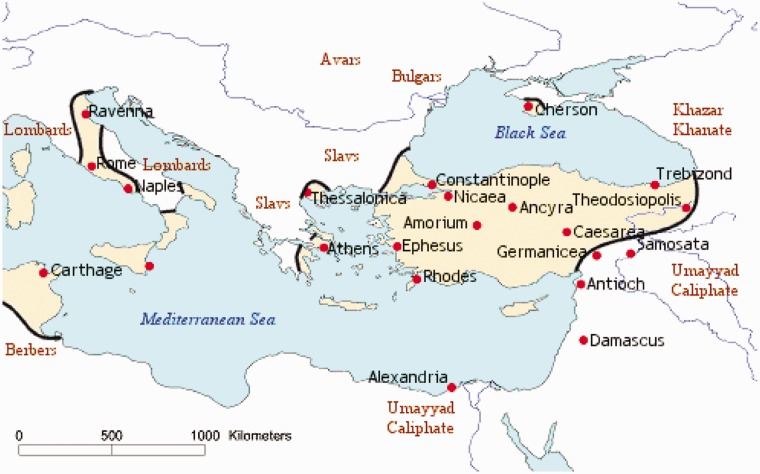
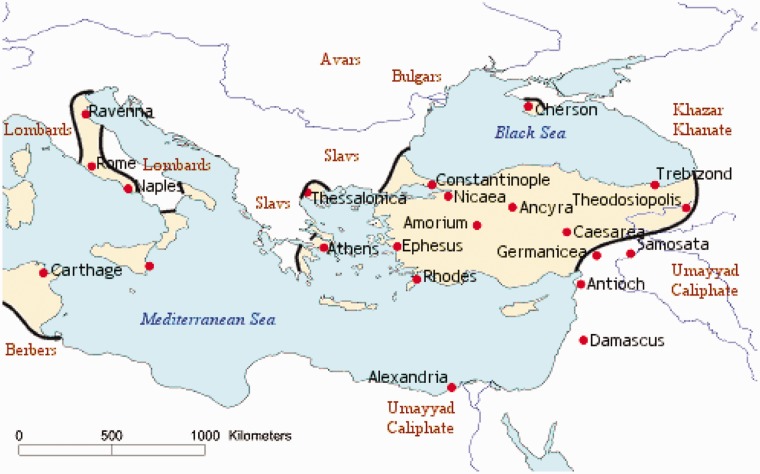
The mainland of the Byzantine Empire in 668 (about one year before al-Hasan’s death) was approximately present-day Turkey (Figure 1). In present-day western Turkey, there are more than 50 mines that contain minerals with deposits of mercury.7 Mercury is isolated from its main ore, cinnabar (mercury(II) sulfide, HgS), and was used in the Mediterranean world for extracting metals by amalgamation as early as 500 BC.6 The element does not have any known biological functions8 and has a long history of toxic effects.6 Mercury(II) chloride (HgCl2), for instance, which was probably first made by Arabic alchemists in the 10th century, was widely used as a violent poison in the Middle Ages.Do the mercury mines in western Turkey contain any mercury species that look like gold?

Fig.1 Map of the Byzantine Empire in 668. (Chris Ambrose, explore Byzantium, http://byzantium.seashell.net.nz/, is credited for the image.)

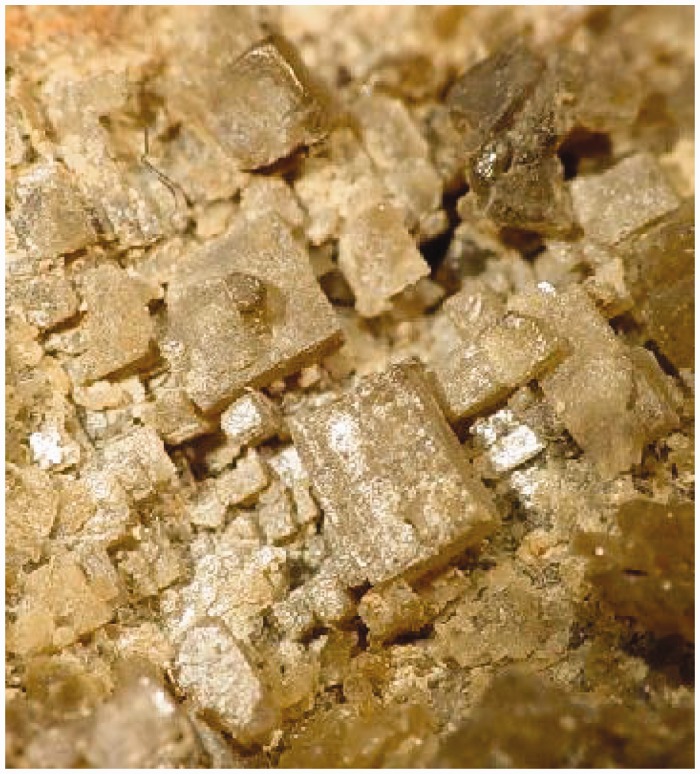
Although abandoned since the 1990s, Türkönü and Haliköy are two important mercury mine locations in Turkey.The Haliköy mine exists in an area made up of metamorphic rocks, including gneiss and schist. Cinnabar and metacinnabar contain mercury and are found in the Haliköy fault. Mine locations also contain deposits of pyrite, marcasite, chalcopyrite, arsenopyrite, quartz, and calcite. The mineral calomel (mercury(I) chloride, Hg2Cl2) is found as a secondary mineral in oxidized zones along with cinnabar, calcite, and limonite. Calomel can present as a yellow gold crust (Figure 2) and forms as tetragonal crystals presenting in a variety of formations, including tabular, prismatic, and pyramidal.

Fig.2 Calomel from Mariposa Mine, Texas, USA. (Rob Lavinsky, The Arkenstone, http://www.iRocks.com, is credited for the image.)

The environmental assessments performed at the mine locations in Turkey have utilized computer programs to aid in analysis of the soil and water samples. The software programs Aquachem and PHREEQCi determined that water samples taken near the Haliköy mine presented with oversaturation with calomel, as well as quartz and cinnabar.

The puzzle of a mysterious death in the Middle Ages has been hypothesized in terms of contemporary forensic legal and scientific methods

Design a site like this with WordPress.com
Get started