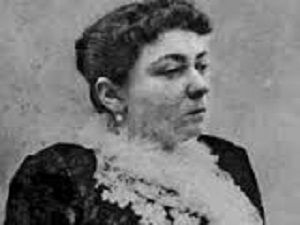
Fatma Aliye was born on 26 October 1862 into a mansion in Istanbul. Her father, Ahmet Cevdet Pasha (1822–1895),was an influential bureaucrat of the Ottoman State, a lawyer and a historian. Her mother was Adviye Rabia Hanım. Fatma had a brother, Ali Sedat, and a sister,Emine Semiye (1864–1944), also a prominent figure in her time, though less so than Fatma.
A Member of the Ottoman Parliament, Fatma Aliye’s father was appointed Governor of Egypt when Fatma was three years old and the family spent the years 1866 to 1868 in Aleppo. When she was thirteen, her father was appointed to another governorship and for six months the family resided in Janina (in the western Ottoman Empire; today Ioannina, Greece).
Fatma Aliye’s early years as the daughter of a traditional Ottoman bureaucrat in the post-Tanzimat period were a mixture of mansion life and the new cultural milieu that accompanied ‘Westernization’ (i.e. political reconstruction through the adoption of ‘Western’ public and legal institutions). Fatma received no formal schooling, since at that time there were no high schools or colleges open to women, but was privately tutored at home until the age of thirteen; her father taught her Arabic, history and philosophy and she also took other private lessons. In 1875,
her father became the Minister of Education. Fatma Aliye, who had now come of age, was not permitted to take lessons with male teachers and ordered to stay away from the selamlık (traditionally the part of the house reserved for men) and move into the harem (the part reserved for women).
In 1878, the family spent nine months in Damascus due to her father’s new position. The following year, at the age of seventeen, Fatma Aliye was married upon her father’s wishes to Captain Mehmet Faik Bey (died 1928), one of the aide-de-camps of Sultan Abdülhamid. It was not a marriage based on love; Aliye’s husband was intellectually far less qualified than she and tried to keep her away from intellectual pursuits—at least for a while. Fatma Aliye gave birth to four girls: Hatice Faik Topuz Muhtar (born 1880); Ayşe Faik Topuz (1884–1967); Nimet Faik Topuz Selen (1900–1972) and Zübeyde İsmet Faik Topuz (born 1901).
In 1885, her husband was posted to the central Anatolian province of Konya for a period of eleven months and Fatma Aliye, who had remained in Istanbul with her children, had the opportunity to return to intellectual pursuits,particularly writing. Later, her husband’s negative attitude to her intellectual life would change and he would even encourage her to publish.
The fact that the Ottoman Empire was ruled by the Shari’a (Islamic law) had an impact not only on religious, but also cultural life.
The dominant ideology of the period aimed at a synthesis between Islam and ‘the West’ and the resulting ‘civilizationalism’ found its way into Fatma Aliye’s views on women and women’s rights. She placed primary importance on the family and regarded women as the driving force of ‘civilization’ via their roles as mothers, emphasizing the need for women’s education,raising the problem of women’s freedom and responsibilities in ‘the family’ and in ‘society,’ and demanding rights for women within these prescribed boundaries. Some of her arguments, calling for sexual equality as well as the preservation of gender differences, reflected widespread currents of nineteenth-century European feminist thought.
Her first translation from French, of George Ohnet’s novel Volonté (Meram in Turkish), was published in 1889. She did not use her own name for the reason that it was then considered inappropriate for a woman to publish and write. In Meram, the translator’s name appeared as “a Lady,” but among intellectual circles it was considered improbable that a woman could have really completed such an impressive translation.
For a long time after, Fatma Aliye employed the pseudonym Mütercime-i Meram (the [female] translator of Volonté), but she published her novel Muhazarat (Useful information, 1892) under her real name. Muhazarat, which came out in a second edition in 1908, was the first novel by a woman in the Ottoman Empire. After its publication,Fatma Aliye’s name began appearing in newspapers and magazines.
For thirteen years (1895–1908), Fatma Aliye wrote the editorial column for the Hanımlara Mahsus Gazete (Newspaper for women). The publication, which came out twice a week, debated women’s issues and provided Turkish women intellectuals (such as Emine Semiye, Fatma Fahrünnisa, Gülistan İsmet, Nigar Osman and Leyla Saz) with a public forum. Aliye’s novels Ra’fet and Udi (The lute player), published in 1898 and 1899 respectively, also dealt with the kinds of subjects discussed in the pages of the Hanımlara Mahsus Gazete, such as women’s entrapment in arranged marriages.
Aliye saw economic independence for women as a solution to this, and many other problems faced by women. Ra’fet and Udi were later translated into French, as was Fatma Aliye’s 1895 book about Muslim women, called Les femmes musulmanes. In a letter (dated 2 April 1895) sent by Nicolas Nicolaides, an editor of ‘L’agence Ottomane’ (a well-known contemporary publisher of works on ‘the Orient’), Aliye was informed that Les femmes musulmanes was being published at the same time by another publisher under another title and writer’s name!
Fatma Aliye’s biography, covering her life until the age of 33, was written by Ahmet Mithat Efendi (a prominent intellectual of the period) and published in 1911 under the title of Fatma Aliye: Bir Osmanlı Kadın Yazarının Doğuşu (Fatma Aliye: the birth of an Ottoman woman writer). Aliye herself co-authored Hayal ve Hakikat (Dream and truth) with Ahmet Mithat Efendi in 1894.
Following her interest in philosophy, Aliye wrote Teracim-i Ahval-i Felasife (Biographies of philosophers,
1900), in which she criticized ‘Western’ writers for their lack of knowledge regarding ‘Eastern’ societies, Muslim women and Islam. In a similar vein, she contributed to written debates with orientalists (such as the writer Emile Julyar) in articles published in French newspapers and wrote Nisvan-ı Islam (Women of Islam, 1896;
translated into French and Arabic) and Taaddüd-i Zevcat’a Zeyl (Polygamy—an appendix, 1899).
Further research by Aliye, published under the title “Ünlü İslam Kadınları” (Famous Muslim women, 1895), aimed to provide readers with examples of publicly active and intellectual ‘Eastern’ women performing socially valued roles. She demanded to know how women could remain so unaware of their own history (a critical issue for women abroad, as well as in Turkey). As a distinguished writer, she won international prestige, appearing in biographies of women writers, having her work exhibited at the library of the World’s Columbian Exposition (Chicago, August 1893) and cited in the catalogue of the Women’s Library at the same World Fair.
Seven years later, she was invited to another exhibition in Paris, but could not accept.
Fatma Aliye is also known as the founder of the first women’s association in the Ottoman Empire, the Cemiyet-i İmdadiye (Charity Society), established after the Greek war of 1897, in order to provide bereaved wives and children, as well as war veterans with material assistance. In recognition of her efforts she received a medal from Sultan Abdülhamid in 1899. She also worked for other charity societies: the Osmanlı Hilal-i Ahmer (Ottoman Red Crescent) and the Müdafaa-i Milliye Osmanlı Kadınlar Heyeti (National Defence Women’s Committee), founded by women following the Tripoli and Balkan Wars of 1911 and 1912.
In order to defend her father and teacher, Ahmet Cevdet Pasha, against political attacks, Fatma Aliye wrote the book Cevdet Paşa ve Zamanı (Cevdet Pasha and his time),published in 1911. Between 1921 and 1929, she traveled to France several times for health reasons and to search for her daughter, Zübeyde İsmet, who had converted to Christianity and left Turkey. In the final years of her life, Aliye’s work did not receive much attention and she suffered increasingly from financial difficulties and poor health. She died on 14 July 1936 in Istanbul.
General neglect of the Ottoman era in Turkish scholarship can be attributed in part to the ideological preferences of the Republican regime, through the decades from the 1920s up until the 1980s. In this latter decade, the number of studies on Ottoman society and Ottoman women began to increase in number and ideological paradigms have since shifted. Fatma Aliye is remembered in Turkish historiography today as a pioneering woman-writer and intellectual.
Serpil Çakır University of Istanbul
SOURCES
(A) Fatma Aliye’s personal archival collection at the Library of Istanbul Municipality. Contains manuscripts, letters, documents and photographs.
For further information see Mübeccel Kızıltan and Tülay Gençtürk, eds. İstanbul Belediye Kitaplığı Fatma Aliye Hanım Evrakı Katoloğu (Istanbul Municipal Library: the catalogued documents of Fatma Aliye Hanım). Istanbul: Istanbul Municipality Publishing, 1993.
(B) Hanımlara Mahsus Gazete (Newspaper for women) (1895–1908).
(C) Fatma Aliye, “Ünlü İslam Kadınları” (Famous Muslim women), Hanımlara Mahsus Gazete (Newspaper for Women), no. 8 (14 September 1895): 3–4 and no. 9 (18 September 1895):
2–3


 Visit Turkey