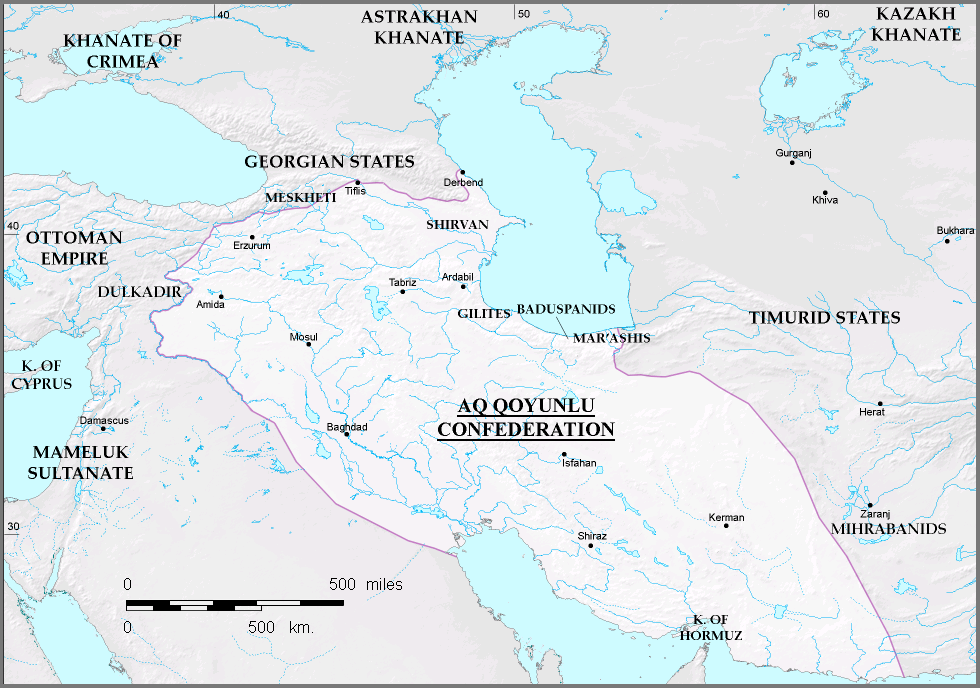
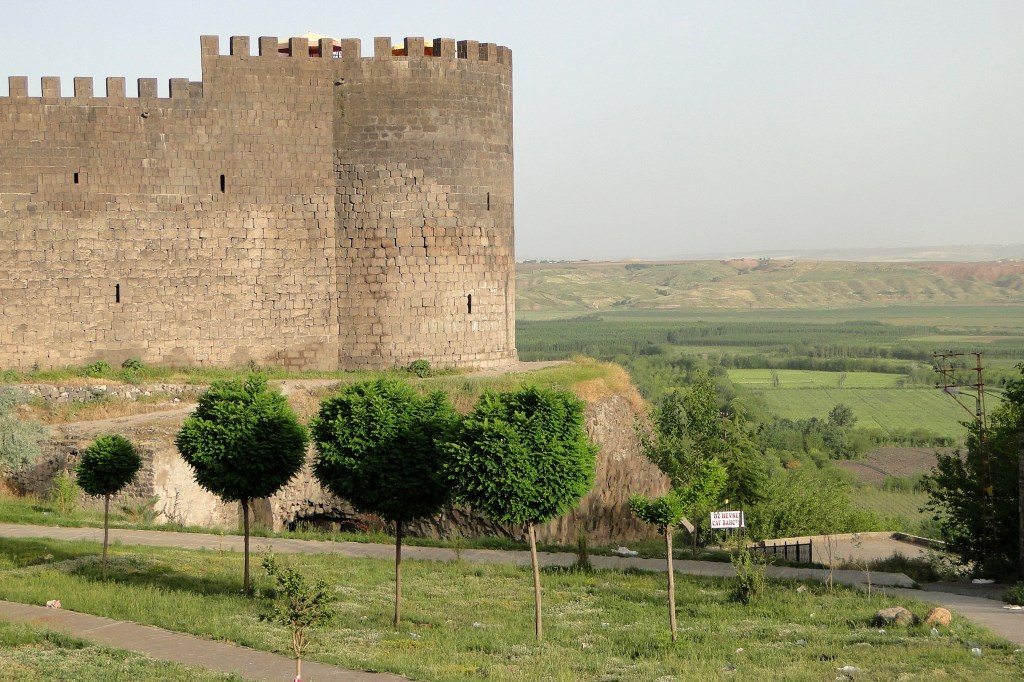
The Ak Koyunlu was one of two rival Turkoman federations, or dynasties (the other being the Kara Koyunlu, or Black Sheep), that ruled parts of Kurdistan during much of the 15th century after the death of the great Mongol conqueror Tamerlane in 1405. Early on, the Sunni Ak Koyunlu had Amed (Di-yarbakir ) as their capital, while the Shia Kara Koyunlu had their center northeast of Lake Van. The Kurds did not play a major role in the armed struggles of the two.
In 1467, the able Ak Koyunlu leader Uzun Hasan destroyed his rival Kara Koyunlu federation and eventually extended his power over most of Kurdistan. According to the Sharafnama , Uzun Hasan then “took it upon himself to exterminate the leading families of Kurdistan, especially those who had shown themselves devoted to or subjects of the Kara Koyunlu sultans.” He made his new capital in Tabriz in what is now Iran . After Uzun Hasan’s death, the Iranian Safavid leader Ismail destroyed the Ak Koyunlu in 1502 and proclaimed himself shah.
The origin of the Āq Qoyunlū tribes likewise remains obscure. Certain groups may have migrated from Central Asia to Anatolia in the 5th/11th century under Saljuq leadership and others in the wake of the 7th/13th-century Mongol invasion. By the end of the Il-khanid period in the mid-8th/14th century, the Āq Qoyunlū were migrating between summer pastures (yeylāq) in Armenia around Sinir, east of Bayburt, and winter pastures (qešlāq) around Kiḡi, Palu, and Ergani in Dīār Bakr.
Their political organization was loose. The highest decision-making authority was a council (kengač) of amirs and tribal chiefs (boy ḵānları) who determined military matters and the recurrent issue of succession to the sultanate; the council’s decisions were binding on the sultan. Military and political control of the adjacent villages and towns, necessary for the safety of the pasturage, was maintained by the army, which consisted largely of tribal levies supporting themselves through their own lands and booty. In addition, the sultan maintained a force of paid personal guards (ḵawāṣṣ) who were recruited from several different nomadic and semi-nomadic groups. The revenue of the Āq Qoyunlū came from taxes and dues levied on the sedentary population of Armenians, Kurds, and Arabs, as well as tolls collected along the main trade routes through eastern Anatolia.
Their territory bordered on lands occupied by other Turkman confederation, namely the Qara Qoyunlū area north of Lake Van, the steppe grazed by the Döḡer east of the middle Euphrates around Rohā (Orfa), and the Ḏu’l-Qadr region west of the river. The Ḏu’l-Qadr confederation had submitted to the suzerainty of the Egyptian Mamluks, whose empire thus stretched up to Malaṭya. Further west lay the Qaramān principality and, north of it, the Eretna principality centered on Kayseri and Sīvās, the strongest of the small states formed in Central Anatolia after the collapse of the Il-khanid Empire. To the north of the Āq Qoyunlū were the Christian kingdoms of Trebizond and Georgia.
In the decade 740-50/1339-49 there were frequent armed clashes between the forces of Trebizond and those of Ṭūr-ʿAlī b. Pahlavān, the first Āq Qoyunlū leader mentioned in mutually independent sources. Peace was arranged in 753/1352 through the marriage of Maria Komnene, a sister of the ruler of Trebizond, Alexios III (1349-90), to Ṭūr-ʿAlī’s son Faḵr-al-dīn Quṭlu. Renewed matrimonial links in later generations maintained the peace, and Trebizond was free from Āq Qoyunlū attacks until it fell to the Ottomans in 865/1461. Ṭūr-ʿAlī died some time between 753/1352 and 764/1363. Under his successor Quṭlu, the Āq Qoyunlū began to intervene in the internal conflicts of the Eretna state. They became its nominal vassals in 783/1381 but supported rebellious military chiefs at Arzanǰān (Erzincan) when Qāżī Borhān-al-dīn (also a prominent poet in Turkish) made himself sultan at Sīvās. When Quṭlu died in 791/1389, the leadership first passed to his son Aḥmad, but Aḥmad’s reckless wavering in the struggles between Sīvās and Arzanǰān finally led to his replacement by his brother Qara Yoluz (or Yülük) ʿOṯmān Beg (on this name, see Roemer, “Das turkmenische Intermezzo,” p. 271, n. 26). In 800/1398 Qara ʿOṯmān revolted against Qāżī Borhān-al-dīn and killed him in battle.
Disorders in northern Syria following the deaths of Qāżī Borhān-al-dīn and the Mamluk sultan Barqūq (r. 784-801/1382-99) gave occasion for conflict between the expanding Ottoman power and the westward-moving conqueror Tīmūr. Voluntarily joining Tīmūr in 802/1399-1400, Qara ʿOṯmān led the vanguard in Tīmūr’s campaigns against Sīvās, whose defenders received Ottoman support (802-03/1402), and against the Mamluk dependencies; he also participated in the battle of Ankara (804/1402), which ended in a crushing defeat for the Ottomans. In recompense, Tīmūr granted him the rank of amir, confirmed his leadership of the Āq Qoyunlū confederation, and made the Bayandor family custodians of the
of the fortress city of Āmed (Dīār Bakr) which before 796/1394 had been held by the Artuqids, a clan of the Döḡer tribe. This is apparently how the Āq Qoyunlū first came into possession of Āmed, which was to be their capital for almost seventy years.
After Tīmūr’s death in 807/1405, Qara ʿOṯmān maintained good relations with his successors. By contrast, the Qara Qoyunlū who had been forcibly subdued by Tīmūr, shook off Timurid suzerainty. Under Qara Yūsof, their leader from 792/1390 to 823/1420, they expelled Tīmūr’s grandson Abū Bakr and killed the latter’s father, Mīrānšāh, the governor of Azerbaijan; they then defeated the Jalayerids to gain control of Baghdad and ʿErāq-e ʿArab (Mesopotamia), conquered parts of Georgia, and penetrated deeper into Iran. The Timurid sultan Šāhroḵ was obliged to launch three campaigns (823-24/1420-21, 832/1429, and 838-39/1434-35) to check their expansion and reimpose his suzerainty. Šāhroḵ’s interventions, together with conflicts among the sons of Qara Yūsof, who had died at the time of the first campaign, weakened the position of the Qara Qoyunlū. In the following years they lost large areas in the west to the Āq Qoyunlū.
Between 823/1420 and Qara ʿOṯmān’s death in 839/1435, the Āq Qoyunlū established their authority in Armenia and Dīār Bakr and moved into Dīār Możar and the western part of Dīār Rabīʿa, an expansion which brought them in conflict with the formerly friendly Egyptian Mamluk sultanate. Accordingly, the Qara Qoyunlū allied themselves with Egypt while the Āq Qoyunlū joined with the Timurids, who were then contesting Egyptian hegemony in the Red Sea; Qara ʿOṯmān also provided support for Šāhroḵ’s expeditions into Azerbaijan. During the third campaign, the aging Āq Qoyunlū leader, at Šāhroḵ’s behest, challenged Qara Yūsof’s son Eskandar to battle near Erzurum, but suffered a severe defeat; he was put to death in Ṣafar, 839/August-September, 1435, and his head was sent by Eskandar to the Mamluk sultan Barsbay (r. 825-41/1422-38) in Cairo.
Qara ʿOṯmān was the real founder of the Āq Qoyunlū state. Under his rule, the confederation not only acquired more territory but also gained support through additional tribes drawn to him by his successes. There are indications that the mainly Christian sedentary inhabitants were not totally excluded from the economic, political, and social activities of the Āq Qoyunlū state and that Qara ʿOṯmān had at his command at least a rudimentary bureaucratic apparatus of the Iranian-Islamic type. Even so, the Turkman military elite clearly remained dominant. From 827/1424 onward, in the hope of counteracting the centrifugal tendencies inherent in a tribal confederation and making the principality more cohesive, Qara ʿOṯmān assigned newly conquered territories to his sons rather than to tribal chefs, but this policy did not produce the expected results (Wood, The Aqquyunlu, pp. 66-70).
Qara ʿOṯmān’s death was followed by prolonged succession struggles in which not only the Mamluks, who had gained temporary recognition from some of the Āq Qoyunlū chiefs, but also the Ottomans, intervened. Qara ʿOṯmān’s designated successor, ʿAlī, could not hold his ground against the claims of his brothers, uncles, and cousins, and in 841/1438-39 he abdicated and went into voluntary exile in Egypt. His brother Ḥamza was then the most powerful Āq Qoyunlū chief, but he died in 848/1444 before he had been able to eliminate all rivals. The struggle for leadership resumed between Shaikh Ḥasan, a son of Qara ʿOṯmān, and ʿAlī’s son Jahāngīr. The situation in eastern Anatolia became critical when Šāhroḵ, the Āq Qoyunlū’s protector and the Qara Qoyunlū’s nominal suzerain, died in 850/1447. Succession disputes in Herat gave the Qara Qoyunlū chief, Jahānšāh b. Qara Yūsof, the chance to secede from the Timurid empire and proclaim himself sovereign. With support from certain Āq Qoyunlū tribal chiefs, he set out on a campaign against Jahāngīr in 854/1450 and, after conquering large parts of Armenia, besieged him in Āmed. Jahāngīr surrendered in the spring of 856/1452 and acknowledged Jahānšāh’s suzerainty. The peace treaty was concluded without the knowledge of Jahāngīr’s younger brother Ḥasan, known as Uzun Ḥasan (Long Ḥasan), who considered it a betrayal. Uzun Ḥasan successfully resumed the war with the Qara Qoyunlū and in the autumn of 856/1452 seized Āmed in a bloodless coup while Jahāngīr was away on a military expedition in Kurdistan (Woods, The Aqquyunlu, p. 91). Repudiating the Qara Qoyunlū suzerainty that his brother had recognized, he sent the keys of the fortress as a token of vassaldom to Cairo and received in return a diploma of appointment to the governorship of Āmed. Jahāngīr made several attempts to recapture Āmed; despite reinforcements from Jahānšāh’s army, he was finally defeated in 861/1457.
Source 1): Black Sheep Turkomans, https://en.wikipedia.org/wiki/Kara_Koyunlu
Source 2):Uzun Hassan
Source 3):The Aqquyunlu
 Visit Turkey