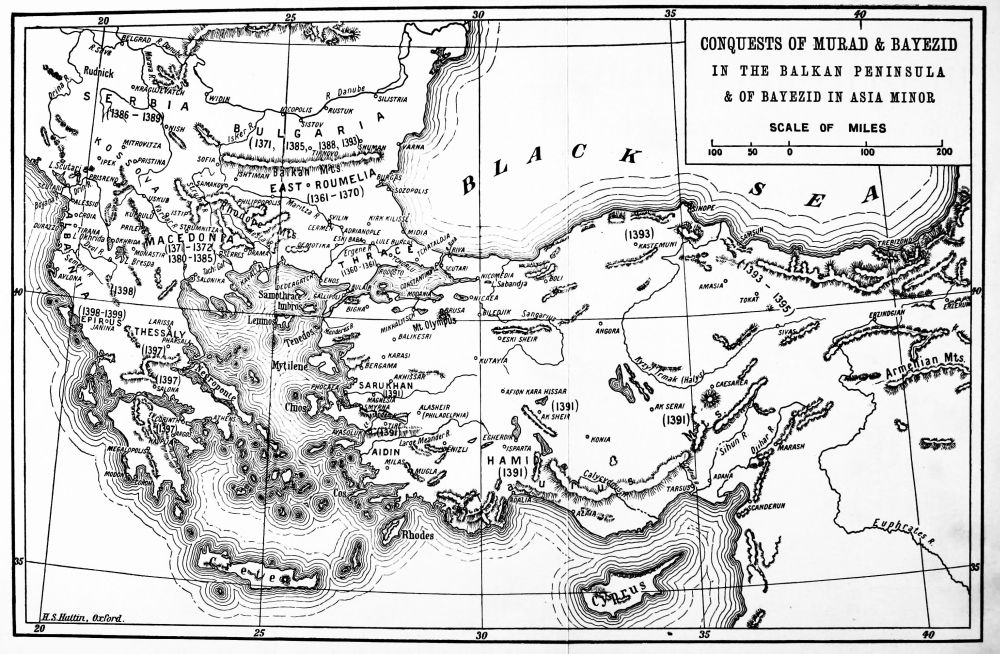
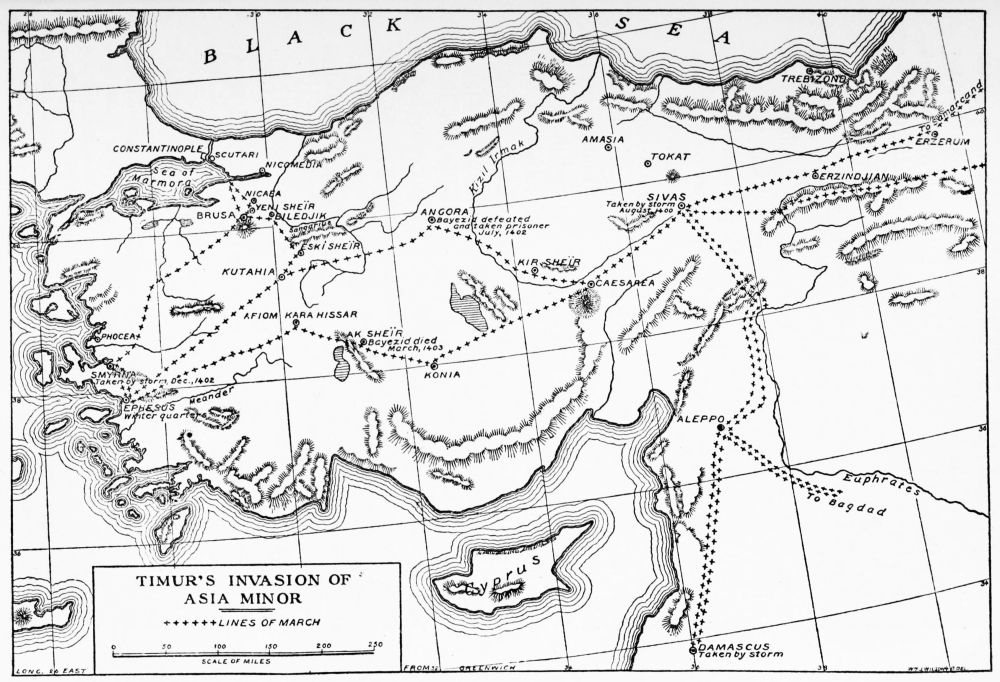
The defeat at Ankara opened a period of political instability combined with social strife. Until 1413 there were sometimes two, sometimes three Ottoman states in conflict with one another. This period is known as the interregnum (fetret devri). Dynastic clashes and social upheaval were to continue within the Ottoman Empire until 1425.
After the conclusion of the treaty and the evacuation of Anatolia by the Mongol army, Suleyman, aiming at sole supremacy over the Ottomans, focused his attention on his two rival brothers. With this end in view, he crossed into Anatolia. It is not clear whom he entrusted with the administration of Rumelia since his vizier, Ali Djandarh, accompanied him. In all likelihood Rumelia was left in the hands of the udj beys. The territory, whose economy had originally been geared to war and conquest, was now confronted with serious problems resulting from the peace, the more so as the number of warriors assembled there had increased with the arrival of those fleeing before the Mongols. However, peaceful relations on the whole were maintained with the neighbouring Christian states, including Hungary which, since the 1360s, had constituted the only real menace to the Ottomans in the Balkans. Furthermore, the Hungarians began to control the production and distribution of metals in central Europe. In Bayazid I’s days King Sigismund of Hungary caused trouble by exerting influence upon several Balkan states. His purpose was to expand his realm from the Black Sea to the Adriatic coast. Nevertheless, his projects regarding the Dalmatian ports caused anxiety to Venice, which avoided an alliance with him against the Turks. Furthermore, during the years following the battle of Ankara, Sigismund was entangled in dynastic strife against his rival, Ladislas of Naples. On the other hand, Ottoman relations with the Venetians, who had occupied some ports in Albania and in Greece, provoked limited military action, the Turks retaliating by harassing Venetian territories and inflicting damage upon Venetian merchants. A new treaty negotiated by Suleyman ended the dispute, the Venetians agreeing to pay annual tribute to him for their new possessions.
In Anatolia Suleyman was first able to eliminate his brother Isa. Early in 1404 he occupied the old capital, Bursa, and the important town of Ankara. He then annexed the Black Sea coast between Herakleia and Samsun, as well as the region of Smyrna, where he obliged Djuneyd to recognise his overlordship. After Timur’s death (1405) the Mongol grasp over Anatolia weakened, and Suleyman was free to turn against his other brother, Mehemmed. The latter, established in a predominantly Turkish milieu, extended his rule from Amasya up to Sivas and consolidated his position by maintaining good relations with the Karamanoglu and with the neighbouring nomadic populations. By marrying the daughter of Dhulkadir, the emir of Elbistan, he obtained access to important military manpower deriving from the tribes of that region. He alone proceeded to assume the title of sultan. A few clashes between the two Ottoman princes came to nothing, and Mehemmed decided to transfer operations to Rumelia.
The instrument of his plans was a fourth brother, Musa, whom he despatched to Rumelia in 1409 with the help of the Isfendiyaroglu. The Byzantine emperor, the Venetians, the Serb ruler and, above all, the Wallachian voivode, Mircea, watching Suleyman’s strong position with anxiety, were ready to support Musa. Mircea received him in his territories and helped him to make preparations against Suleyman. When the latter was obliged to return to Rumelia in 1410, Mehemmed easily became the lord of the whole of Ottoman Anatolia. After a series of military operations, Musa emerged victorious, while Suleyman lost his life in February 1411.
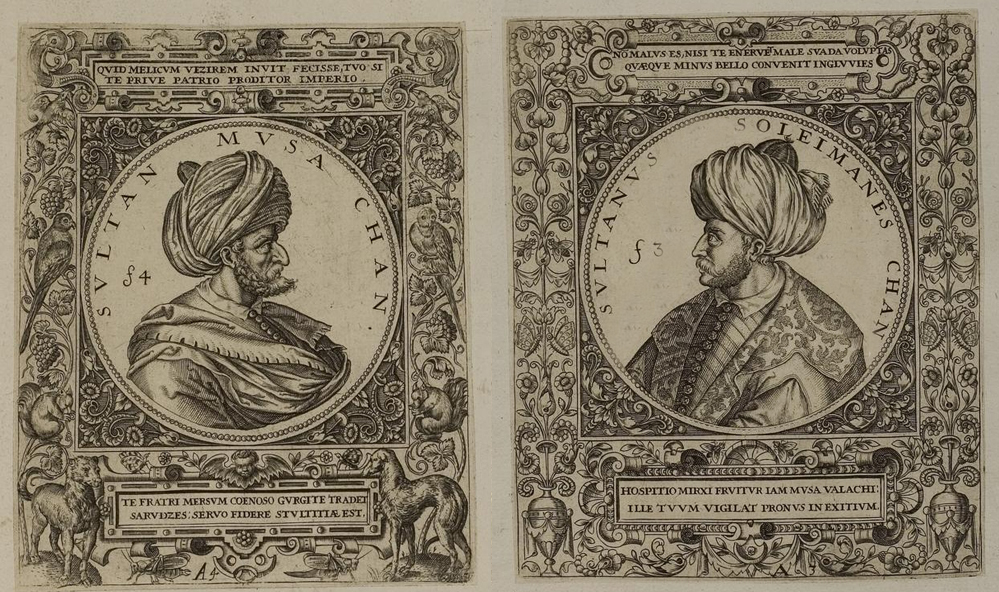
At the beginning Musa, established in Edirne, governed the European provinces as a vassal of his brother, Mehemmed, who had moved to Bursa. When still fighting against Suleyman, Musa repudiated promises made to the Christian lords who had supported him, and revived the spirit of the holy war. Thus he won the support of the military who had long refrained from raiding Christian territories. He soon launched attacks on all directions and besieged Thessalonica and Constantinople.
Alarmed, the Christian lords turned to Mehemmed. Several high Ottoman officials, who had been connected with Suleyman’s administration and, for this reason, had been persecuted by Musa, also joined Mehemmed, and a new struggle for sole supremacy over the Ottoman state began in 1412. For a while, Musa’s position appeared strong, but defections to Mehemmed’s side increased while the Byzantine emperor also offered him his help. Musa was finally defeated near Sofia and killed in 1413. The period of the interregnum was now ended, Mehemmed becoming the sultan of a reunited state and being generally recognised as his father’s legitimate successor. Official Ottoman tradition would never consider Suleyman and Musa as real sultans.
Mehemmed, well aware that his territories had been devastated by the civil wars and that the unity of his state was only fragile, adopted a policy of peace towards the Christians. His intention was facilitated by the hostility prevailing among his main enemies, Venice and Hungary. Having insured peace in Rumelia, the sultan consolidated his position in Anatolia by defeating the Karamanoglu, who, profiting from the civil war, had besieged Bursa. He also put a temporary end to the separatist movement of Djuneyd in Smyrna, whom he sent to Nicopolis as an udj bey of the Danube frontier.
The Christian enemies of the Ottoman state tried to divide it once again, and a new pretender to the Ottoman throne appeared on the scene with the help of the Byzantines, the Wallachians and the Venetians, who now had established contacts with the emir of Karaman. He was Mustafa, who passed into history as the ‘false’ one (duyme) because Mehemmed’s milieu claimed that he was not Bayazid I’s son at all, but simply an impostor. Like Musa, Mustafa, with the help of the voivode Mircea, set off from Wallachia. Djuneyd joined him, abandoning his post at Nikopolis. Soon both were defeated by Mehemmed’s troops near Thessalonica and compelled to take refuge with the Byzantines (1416).


 Visit Turkey