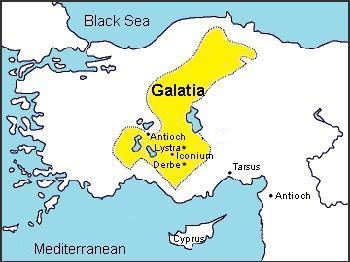
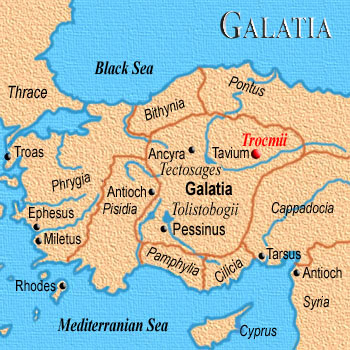
In the strict sense (Galatia Proper, Roman Gallograecia) this is the name applied by Greek-speaking peoples to a large inland district of Asia Minor since its occupation by Gaulish tribes in the 3rd century B.C. Bounded on the N. by Bithynia and Paphlagonia, W. by Phrygia, S. by Lycaonia and Cappadocia, E. by Pontus, it included the greater part of the modern vilayet of Angora, stretching from Pessinus eastwards to Tavium and from the Paphlagonian hills N. of Ancyra southwards to the N. end of the salt lake Tatta (but probably including the plains W. of the lake during the greater part of its history), – a rough oblong about 200 m. long and ioo (to 130) broad.
To designate a large province of the Roman empire, including not merely the country Galatia, but also Paphlagonia and parts of Pontus, Phrygia, Pisidia, Lycaonia and Isauria. The name occurs in 1 Corinthians 16:1 Galatians 1:2 1 Peter 1:1, and perhaps 2 Timothy 4:10. Some writers assume that Galatia is also mentioned in Acts 16:6; Acts 18:23; but the Greek there has the phrase “Galatic region” or “territory,” though the English Versions of the Bible has “Galatia”; and it must not be assumed without proof that “Galatic region” is synonymous with “Galatia.” If e.g. a modern narrative mentioned that a traveler crossed British territory, we know that this means something quite different from crossing Britain. “Galatic region” has a different connotation from “Galatia”; and, even if we should find that geographically it was equivalent, the writer had some reason for using that special form.
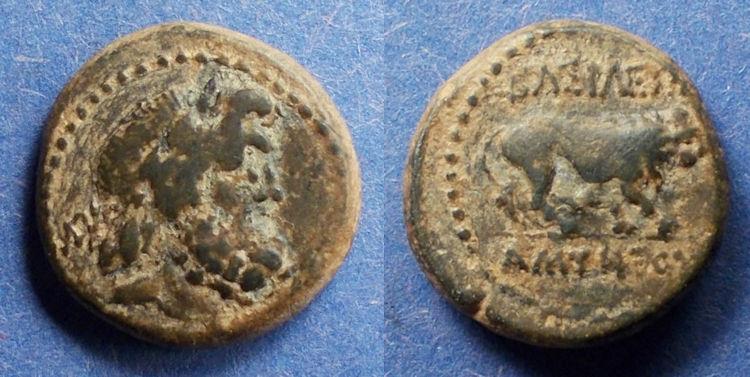
Laureate head of Zeus right
Lion walking right “BASILEWS AMYNTOY”
SNG Von Aulock 6106 (same dies)
Rare type with Zeus instead of Herakles on the obverse
Given the consonant shift proposed for the Belgae, then ‘Belgae’ would indicate that its ‘b’ replaced an older (?) form of a ‘w’ sound. This supplies ‘Welgae’ as a possible older form of Belgae, and rather astonishingly that ‘wel-‘ sounds incredibly similar to what the Germans call Celts! So the possibility is raised that the original ethnic name was ‘Wel’, and while the Belgae were in northern central Europe this mutated into ‘vel’ and then ‘bel’; while in the west and south the ‘w’ of ‘wel’ acquired a hard ‘k’ or ‘g’ in front of it, to form ‘kwel’ or ‘gwel’, therefore giving rise to words such as ‘celtae’ and ‘galati’. Curiously, a Belgic origin is often claimed for the Galatian Celts. Given the marked Belgic features found in names for the Taurisci and Scordisci, could the entire Balkans settlement by Celts have been of a Belgic origin? Ritual death practices by the Galatians also appears to provide backup for this.
The Tolistoboges (or Tolostobogi), who seem to have been entirely anonymous before the migration, were said by Strabo to have taken their name from their leaders. This indicates a mixed group from several tribes that needed to find its own identity, which explains the tribe’s previous anonymity. Other sources claim the Tolistoboges as the Tolistoboii, a division of the greater Boii. The ‘g’ in ‘boges’ is pronounced as a ‘gh’, a guttural ‘h’. So the tribe would be Tolisto-boii (‘bo-hee’ with a strong ‘h’), thereby supporting both versions of the name – it’s simply down to pronunciation. As far as breaking down the name goes, ‘tolisto-‘ is probably a man’s name, a leader named Tolistos or Tolistorix (a ‘King Tolistos’, possibly the father or grandfather of Brennus?). The proto-Celtic word list has ‘listo’ defined as a nickname without any further explanation, but another section indicates that it might mean an adopted or fostered relative: *(φ?)listo-makʷ(kʷ)o- (?), meaning ‘stepson’. The initial ‘to-‘ is probably the pronoun, ‘you’. The tribe were the ‘Boii of Tolistos’, thereby affirming their link to this large collective.
The Trocmes (or Trocmi, Trogmi) were equally unknown before their migration. Trogmi or Trocmi appears to have some very strange possibilities when it comes to breaking it down. On the one hand it might derive from ‘trougos’, meaning ‘misery’. Or it is more likely to be ‘trokkos’, meaning ‘to bathe’. The ‘m-‘ on the end appears to be a personal pronoun, ‘me’ or ‘mi’. So the most likely meaning is ‘I bathe’, which is good to know! The alternative may mean ‘I am miserable’ or something similar – hardly an inspiring tribal name.
Pliny the Elder mentions the Ambitouti and Voturi, apparently as divisions of the Tolistoboges. The Ambitouti name can be broken into two parts, staring with an old friend, ‘ambi-‘, meaning on both sides, or providing an extended meaning of universally, which is also used by tribes such as the Ambarri, Ambidravi, and Ambisontes. The second part of the name, ‘touti’, means the ‘tribe or folk’. They were probably ‘all of the people’, possibly in the same sense as the Celtic ‘combrogi’, meaning ‘people of the same land’ or more specifically ‘brothers-in-arms, compatriots’, which was used by the Sicambri and others. As for the Voturi, the closest option in proto-Celtic seems to be *wor-tero- < *wer-tero-, meaning ‘noble’. They were ‘the nobles’ or similar.
The Teutobodiaci are another apparent splinter group that is mentioned by Pliny the Elder. Breaking it down, ‘teuto’ is ‘people or tribe’, while ‘bodiaci’ appears to be the name Boudicca (which was also used by the famous queen of the Insular Iceni). The female form is Boudicca, while the male form is Boudiccos. The were ‘the people of Boudiccos’, possibly one of their founding tetrarchs.
The Arecomisci tribe settled a wide swathe of what is now south-eastern France, occupying the entire central and western parts of the later Roman province of Narbonensis. They appear to have been a branch of the widely-travelled Volcae collective, some of which, elements of the Volcae Tectosages, moved to Anatolia. Once there, they and the other Gauls formed capitals for each of their various divisions. The Tectosages were centred on Ancyra (modern Ankara, the Turkish capital). The Tolistoboges located themselves at ancient Gordion (resting place of, arguably, Gordios III of Phrygia). The Trocmes based themselves at Tauion (Tavium, location uncertain). They organised a system of four ‘tetrarchies’ to each tribe, each of which sent twenty-five representatives to a great council that would handle matters of national importance. The heavily-Hellenicised descendants of these tribes formed a kingdom in the first century BC which quickly became a Roman client state.
(Information by Peter Kessler and Edward Dawson, with additional information from The La Tene Celtic Belgae Tribes in England: Y-Chromosome Haplogroup R-U152 – Hypothesis C, David K Faux, from Commentarii in Epistulam ad Galatas II, 3 = Patrologia Latina 26, 357, St Jerome, from Guide for Greece, Pausanias, and from External Links: Journal of Celtic Studies in Eastern Europe and Asia-Minor, and The Works of Julius Caesar: Gallic Wars, and Geography, Strabo (H C Hamilton & W Falconer, London, 1903, Perseus Online Edition).)
The questions that have to be answered are: (a) In which of the two senses is “Galatia” used by Paul and Peter? (b) What did Luke mean by Galatic region or territory? These questions have not merely geographical import; they bear most closely, and exercise determining influence, on many points in the biography, chronology, missionary work and methods of Paul.
The name was introduced into Asia after 278-277 B.C., when a large body of migrating Gauls (Galatai in Greek) crossed over from Europe at the invitation of Nikomedes, king of Bithynia; after ravaging a great part of Western Asia Minor they were gradually confined to a district, and boundaries were fixed for them after 232 B.C. Thus, originated the independent state of Galatia, inhabited by three Gaulish tribes, Tolistobogioi, Tektosages and Trokmoi, with three city-centers, Pessinus, Ankyra and Tavia (Tavion in Strabo), who had brought their wives and families with them, and therefore continued to be a distinct Gaulish race and stock (which would have been impossible if they had come as simple warriors who took wives from the conquered inhabitants). The Gaulish language was apparently imposed on all the old inhabitants, who remained in the country as an inferior caste. The Galatai soon adopted the country religion, alongside of their own; the latter they retained at least as late as the 2nd century after Christ, but it was politically important for them to maintain and exercise the powers of the old priesthood, as at Pessinus, where the Galatai shared the office with the old priestly families.
c.300 BC
The last stages of Hallstatt culture sees Celts involved in a great expansion into southern and eastern Europe. Tribes infiltrate across the Danube to enter the land on the southern edge of the Eastern Alps, in the form of the Latovici, Serapili, Sereti, and Taurisci. The native communities in the hinterland of the Adriatic between Carinthia and Carniola are relatively rapidly assimilated by the Celtic newcomers, soon losing their identity completely. The migration turns into a powerful juggernaut as it enters the Balkans to come up against the Thracian and Greek kingdoms. It is unclear whether later La Tène elements of Celtic culture are also involved, but it is entirely possible.
c.282 – 281 BC
Gauls who are settled in Pannonia begin a series of campaigns southwards towards Thrace under the leadership of Cambaules. The first two campaigns see Cambaules and his leading veterans divide their followers, sending one part against the Thracians and Triballi under Cerethrius, a second against Paeonia under Brennus and Acichorius, and a third against the Macedonians and Illyrians under Bolgios.
279 BC
Despite ruling both the Lysimachian empire and Macedonia, and having his main rival, the Antigonid King Antigonus II Gonatas bottled up in his own capital, Ptolemy II Ceraunus is killed in the invasion of Greece by the contingent under Bolgios. The kingdom is plunged into anarchy as the Celts invade further into Greece, and only the Aetolians seem to be able to take the lead in defending Greek territory.
278 – 277 BC
Brennus and Acichorius lead the third campaign by the Celts, although this is eventually defeated by a force led by the Aetolians. Following victory at Thermopylae, they advance to Delphi in 278 BC where they are routed by the Greek army, and then suffer a crushing defeat (under Cerethrius) at the hands of the Antigonid King Antigonus II in 277 BC. With Brennus dead, they retreat from Greece and pass through Thrace to enter into Asia Minor, although a small contingent (around 20,00 people, half of whom are warriors) under the leadership of Liutarius and Leonnarius already seems to have made the journey in 278 BC, with the rest merely following a now-established route in their wake.
These Celts in Anatolia (centred on lands that are taken from Antigonid Phrygia) form tribal regions that are based around each of the three main constituents of the confederation. The Tectosages base themselves at Ancyra (modern Ankara, with their leaders shown below in black), while the Tolistoboges settle at Gordion (to the west of Ankara, shown in green), and the Trocmes concentrate themselves at Tauion (shown in red), all in Anatolia. A separate kingdom is established in Thrace, at the city of Tilis (shown in light grey).
The far larger remnant of Gauls who remain in the Balkans join together to form a confederation that finally settles at the junction of the rivers Savus and Danube in the Balkans. They adopt a name which highlights their acceptance of this territory as their new home, taking the mountain’s name itself as the ‘people of the Scord’ – the Scordisci. They probably pick up elements of many of the local peoples along the way, Dacians, Illyrians, and Thracians. From there they raid into Macedonia, weakening the kingdom and later forcing a good many of the Roman governors there to campaign against them during the late second and early first centuries BC.
278 – ? BC
Liutarius
278 – ? BC
Leonnarius
c.278 BC
Outside of Anatolia, the westernmost portion of Galatia is the Celtic kingdom that is established at Tilis (or Tylis, Tyle). This city in eastern Thrace and its Celtic occupiers are both mentioned by Polybius in relation to Commontorios setting up his own kingdom in the wake of the Celtic rampage through the Balkans. The city of Tilis is located near the eastern edge of the Haemus (Balkan) Mountains in what is now eastern Bulgaria (the modern Bulgarian village of Tulovo in Stara Zagora province now occupies the site).
c.278 – c.250 BC
Commontorios / Kommotorios
275 BC
The Galatians seem to be expanding the territory they command, presenting a growing threat to the eastern kingdoms in Anatolia. The Seleucid king in Syria, Antiochus I, attacks the Galatians from the east. Defeating them at the Battle of the Elephants, he pushes back their borders and, allegedly, gains the title ‘soter’ (meaning ‘saviour’) thanks to his victory.
273 BC
The Celts invade Thrace again, destroying the Thracian kingdom and forcing the Greek aristocracy to escape to the colonies bordering the Black Sea. The kingdom of Galatia now covers territory from the lower Balkans to Anatolia. Its victorious creators settle down to life that is fairly traditional, although they have adopted an internal organisation that is much enhanced, with separate judges and military commanders who are all subject to the regional tetrarch. Some Celts at least learn to read Greek, although whether any records are kept by the Celts themselves in any language, Greek or otherwise, is doubtful.
230 BC
The city of Pergamum has been ruled as an Hellenic domain of the Lysimachian empire (during the lifetime of Satrap Philetaerus), with the city being turned into a fortress to house many of the Lysimachian riches. It is only with the success now of Attalus against the Galatian Celts that an independent kingdom is proclaimed in 230 BC, although it still remains within Greece’s sphere of influence.
? – c.218 BC
Kavaros
214 BC
The Thracians eject the Celtic kingdom of Galatia from Greece and fully restore Thracian rule. Only the Celtic kingdom at Tilis in eastern Thrace remains in Celtic hands. The early Galatian kingdom (or rather, confederation) has over-extended itself by claiming too much territory. Now it faces pressure from east and west and its borders contract.
212 BC
The Celtic kingdom that is based at the city of Tilis (or Tylis) in eastern Thrace is attacked by Pleuratus, would-be king of Thrace who may reign in opposition to the already-established Seuthes IV. The kingdom is apparently destroyed by the action, as is the city itself.
c.200 BC
By now Galatia has been settled for almost a century around the River Halys and the Phrygian plain – the poorest parts of Anatolia. According to Pliny the Elder, it lies ‘above’ Phrygia and includes the greater part of the territory taken from that province, along with its former capital at Gordion (Gordium). The Gauls of these parts are called the Tolistobogi (Tolistoboges), the Voturi and the Ambitouti. The latter seem to be divisions of the Tolistoboges, never apparently having been mentioned in history at any time prior to this appearance.
The Gauls of Maeonia and Paphlagonia are called the Trocmi (Trocmes). Cappadocia stretches along to the north-west of Galatia, with its most fertile regions being in the possession of the Tectosages and Teutobodiaci. The latter is another new group, or division, presumably from the main host of Tectosages.
Transference to Rome:
The Galatian state of the Three Tribes lasted till 25 B.C., governed first by a council and by tetrarchs, or chiefs of the twelve divisions (four to each tribe) of the people, then, after 63 B.C., by three kings. Of these, Deiotaros succeeded in establishing himself as sole king, by murdering the two other tribal kings; and after his death in 40 B.C. his power passed to Castor and then to Amyntas, 36-25 B.C. Amyntas bequeathed his kingdom to Rome; and it was made a Roman province (Dion Cass. 48, 33, 5; Strabo, 567, omits Castor). Amyntas had ruled also parts of Phrygia, Pisidia, Lycaonia and Isauria. The new province included these parts, and to it were added Paphlagonia 6 B.C., part of Pontus 2 B.C. (called Pontus Galaticus in distinction from Eastern Pontus, which was governed by King Polemon and styled Polemoniacus), and in 64 also Pontus Polemoniacus. Part of Lycaonia was non-Roman and was governed by King Antiochus; from 41 to 72 A.D. Laranda belonged to this district, which was distinguished as Antiochiana regio from the Roman region Lycaonia called Galatica.
- The Roman Province:
This large province was divided into regiones for administrative purposes; and the regiones coincided roughly with the old national divisions Pisidia, Phrygia (including Antioch, Iconium, Apollonia), Lycaonia (including Derbe, Lystra and a district organized on the village-system), etc. See Calder in Journal of Roman Studies, 1912. This province was called by the Romans Galatia, as being the kingdom of Amyntas (just like the province Asia, which also consisted of a number of different countries as diverse and alien as those of province Galatia, and was so called because the Romans popularly and loosely spoke of the kings of that congeries of countries as kings of Asia). The extent of both names, Asia and Galatia, in Roman language, varied with the varying bounds of each province. The name “Galatia” is used to indicate the province, as it was at the moment, by Ptolemy, Pliny v.146, Tacitus Hist. ii0.9; Ann. xiii. 35; later chroniclers, Syncellus, Eutropius, and Hist. Aug. Max. et Balb. 7 (who derived it from earlier authorities, and used it in the old sense, not the sense customary in their own time); and in inscriptions CIL, III, 254, 272 (Eph. Ep. v.51); VI, 1408, 1409, 332; VIII, 11028 (Mommsen rightly, not Schmidt), 18270, etc. It will be observed that these are almost all Roman sources, and (as we shall see) express a purely Roman view. If Paul used the name “Galatia” to indicate the province, this would show that he consistently and naturally took a Roman view, used names in a Roman connotation, and grouped his churches according to Roman provincial divisions; but that is characteristic of the apostle, who looked forward from Asia to Rome (Acts 19:21), aimed at imperial conquest and marched across the Empire from province to province (Macedonia, Achaia, Asia are always provinces to Paul). On the other hand, in the East and the Greco-Asiatic world, the tendency was to speak of the province either as the Galatic Eparchia (as at Iconium in 54 A.D., CIG, 3991), or by enumeration of its regiones (or a selection of the regiones). The latter method is followed in a number of inscriptions found in the province (CIL, III, passim). Now let us apply these contemporary facts to the interpretation of the narrative of Luke.
III. The Narrative of Luke.
- Stages of Evangelization of Province:
The evangelization of the province began in Acts 13:14. The stages are:
(1) the audience in the synagogue, Acts 13:42;
(2) almost the whole city, 13:44;
(3) the whole region, i.e. a large district which was affected from the capital (as the whole of Asia was affected from Ephesus 19:10);
(4) Iconium another city of this region: in 13:51 no boundary is mentioned;
(5) a new region Lycaonia with two cities and surrounding district (14:6);
(6) return journey to organize the churches in (a) Lystra, (b) Iconium and Antioch (the secondary

 Visit Turkey