Essential oils are primarily used in food and perfume production. Rose oil, a member of this group, is especially important in the cosmetic industry. Turkey and Bulgaria are the most important producers in the world. The rose flowers have produced for many years in Turkey. Most of them are grown as organic products and processing. In this study, we review the production, cultivation, trade and marketing of rose oil, with a primary focus on Turkey as a major producer. In addition, problems and proposed solutions relating to the rose oil business in Turkey are also presented.
Because of Turkey’s location and climate, many medical and aromatic plants are cultivated or obtained from the wild and many of these are specifically cultivated organically. Essential oils are obtained from plant flowers, leaves, fruit, seeds, stems and roots. There are many essential oil yielding plants grown in Turkey and the rose is among the most important and popular. In this study, we summarize Turkey’s rose oil production and marketing potential within the context of world rose oil market and review problems and present suggestions on how to improve Turkey’s rose oil production and marketing.
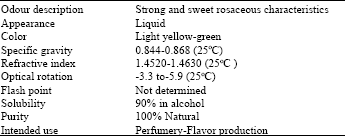
Characteristics and production of rose oil: Turkish Rosa damascena products can be grouped in four categories: Rose Oil, Rose Concrete, Rose Water and Rose Absolute. The physical and chemical characteristic of Turkish rose oil is as follows
produced by processing the rose flower. Roses are gathered in May-June when a 40-day flowering season occurs. Humidity and cloudiness during the season have an effect on the yield and quality of rose oil. The content of essential oil in the rose petals is poor- far below 1%. Because of the volatility of rose oil, content is the highest first thing in the morning when the flowers open; therefore, rose flowers used for distillation are picked manually, daily and before or at sunrise. Roses used for oil production are usually grown without using chemicals. There are two methods for rose oil distillation in Turkey: the traditional but slowly disappearing village-type distillations using long-fired crude copper still known as Imbeks and the modern factory production method using hydro-steam distillations called Kanas. The quality of rose oil produced by these two methods is same.
Characteristic components of rose oil are acyclic monoterpene alcohols, geraniol (up to 75%), citronellol (20%) and nerol (20%) and long-chain hydrocarbons like nonadecane or heneicosane (up to 10%).
An important trace component of rose oil is β-damascenone: Despite its low concentration (0.01%), C13-norisoprenoid has a notable influence on the quality of the oil; together with the structurally related compounds β-damascone and β-ionone, it is enzymatically generated from carotenoids. Similarly, in both saffron and pandanus leaves, the dominant aroma molecules derive from enzymatic degradation of carotenoids.
Characteristic of the fresh flower’s odour is 2-phenyl ethanol, which, though lost during steam distillation, accumulates in the rose water. Rose oil is obtained from the flowers of the oil-bearing rose (Rosa damascena) through water distillation. Thus, rose oil and rose water do not equal each other exactly. Even in the best case, only 10 g of the essential oil are distilled from as much as 100 kg fresh rose flowers (0.01%).
The most important rose oil producer countries are Turkey and Bulgaria. Combined, these two countries produce 80% of total rose oil supply. In 2001, world-wide rose oil production was 4.5 tons and 2-2.5 tons of this were from Turkey. Bulgaria produced 1.5 tons of the world wide total and an additional ton was supplied by Morocco, Iran and Mexico combined.
World rose oil annual consumption is much lower than the combined annual production total; in fact, yearly consumption is between 3.5 and 4.0 tons. This causes rose oil producer companies to carry product (stock) over from year to year. As a result, fluctuations in prices are encountered, with the severity of these fluctuations dependent on how aggressively companies compete for business and find additional customers for their products.
Gulbirlik, the successful Turkish rose market cooperative, determines rose oil pricing for Turkey’s private sector. The export price of rose oil is the main factor in determining the flower price. The flower’s share of total price of rose oil is 55%. It is reported that the total cost for rose flower production is 52.3% for labor, 17.7% for machinery, 12.8% for materials, 11.8% for field rent and 5.5% for draft animal power in Turkey.
Turkey is one of the leading rose flower producing countries, surpassed only by Bulgaria. For over 100 years, roses have mainly been grown in Turkey in Isparta county, in the Southwest part of Anatolia. Roses are also grown in some other parts of Turkey such as Afyon, Burdur and Denizli district. The production of oil rose (Rosa damascena) started in Isparta in 1888 and the first commercial production of rose oil was accomplished in 1892. In addition the first modern plant for rose oil production was build (established) as cooperative in 1953.
Currently, approximately 2-2.5 tons of rose and 4-4.5 tons of rose concrete are annually produced in Turkey. 8.200 families grow oil roses and 0.5-1.0% of total cultivated land in Turkey is used for rose production.
On average, 1 kg of rose oil is extracted from 3 to 5 tons of rose flower leaf. Rose oil is stream distilled from Rosa damascena flowers and rose oils, extracts and derivates are among the most important natural perfume ingredients[5]. These have remarkable diffusive power and are used in many types of perfume bases, blending particularly well with other floras. Rose oil is very expensive oil[3]. In fact, the price of the rose oil has averaged between 3.800 and 4.000 $ kg-1 and its highest price was 4.200 $ kg-1. The short flowering time of the Rosa damascena is a key reason for its high price[10]. There is competition between Turkey and Bulgaria for this market. Earlier maturation in Bulgaria[11,12] leads oil producers to prefer Bulgaria and this affects world rose oil price fluctuations.
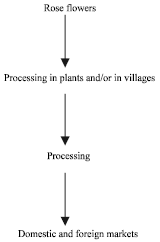
In plants with modern techniques 96.92% of rose flowers is processed[8]. The rose oil produced is mostly exported to foreign countries especially in the EU. This is one of the main reasons for an inadequate cosmetic industry in Turkey (Fig. 1).
Export of essential oils and rose oil in the world and Turkey: Based on the 2001 values, the essential oil world-wide export and import markets realized 7.3 and 5.5 billion $, respectively. Difference between these two values were caused by the re-export of different derivatives of essential oils and exports in the last months of any year taking the place of import values in the next year. Sometimes, transportation takes a few months. Consequently, this results in significant differences between the product and monetary amount. It is possible to follow a similar situation between FOB prices in export and CIF prices in import and also in the monetary values of exports and imports. The monetary values of essential oil trade in the world are shown in Table 1.
The EU countries, plus the USA and Japan, are the main importers of essential oils, accounting for 80% of total imports. Turkey’s worldwide essential oil export trade reached 8.6 million $ in 2000, 9 million $ in 2001 and 11.6 million $ in 2002 year. In addition, the import value was 3.3 million $ in 2000 and 2001 and reached 5.6 million $ in 2002[13].
Turkey’s share of the world essential oil trade has been as low as 0.16% with a value of 11.6 million $; but her rose oil export share is a much higher 40-45%.

 Visit Turkey